
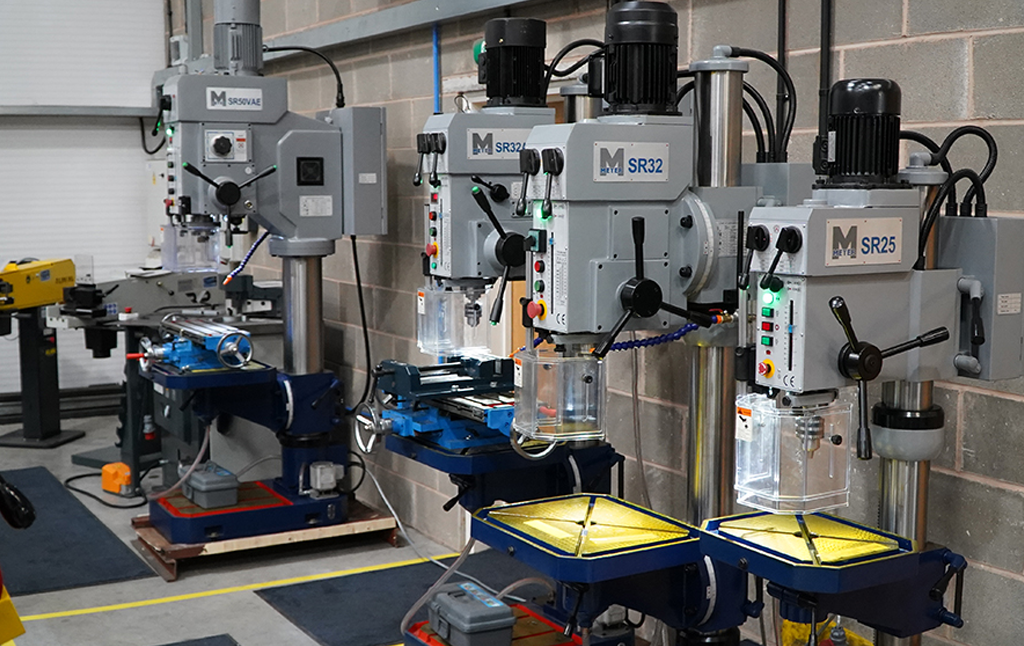
A pillar drill might be one of the most familiar machines in the workshop, but choosing one for daily production takes more than matching a motor size to a budget. A small bracket, a long section and a heavy plate ask very different things of the drill, the table and the person operating it.
This guide explains the specifications that matter when drilling and tapping metal, then shows where a belt-driven or geared-head Meyer machine may fit. If you already know your hole sizes, material and weekly workload, you can explore the Meyer pillar drill range alongside the guide.
Start with the workpiece, not the drill bit
Write down the largest hole you need to drill, but also note the material, thickness and hole position. The stated drilling capacity is a useful starting point, not a promise that every tool, material and duty cycle will behave the same way. A large hole in a tough steel plate can demand considerably more from a machine than an occasional hole in a softer material.
Next, measure the distance from the edge of the largest part to its furthest hole. The drill’s throat depth determines whether that position can sit under the spindle. Also check the usable table area, spindle travel and clearance when the part is clamped. A machine can have adequate drilling capacity and still be awkward for your actual component.
If you regularly drill heavy fabrications, think about material handling too. How will the part reach the table, and how will you support an overhanging section? A good specification considers the whole job, not just the spindle.
Read our separate guide to drilling capacity, throat depth and working height before comparing models.
Choose the drive and speed range for the job
Selmach’s Meyer range includes both belt-driven and geared-head pillar drills. Belt-driven machines can be a practical choice for general workshop drilling. A geared head is worth considering when the work is frequent, the materials are demanding or operators need a robust speed selection across different jobs. Neither label on its own tells you whether the machine is correctly sized: compare speed range, drilling capacity, duty and the workpiece.
The Meyer SL32 belt-driven pillar drill and the Meyer SR25 geared-head model illustrate the two approaches. Our belt-driven versus geared-head guide walks through the choice in more detail.
Decide whether drilling alone is enough
If threading holes is a regular part of production, check the machine’s tapping capacity and controls as carefully as its drilling capacity. A separate manual tapping stage adds handling and can interrupt an otherwise simple workflow. Likewise, powered feed may help when operators repeat the same operation through a shift, but it should be selected for the job rather than treated as a default upgrade.
The Meyer SR32AE combines drilling, tapping and powered feed. Selmach’s SR32AE operating guide shows those functions in use. For a buying decision, see when power feed and tapping pay their way.
Check that the workpiece can be held and reached
Consider the table size and adjustment, the spindle-to-table clearance, guarding, coolant and the way you will secure the part. A vice or clamping arrangement needs room; an unstable workpiece is not fixed by buying a larger drill. Make sure the selected tooling and fixture suit the operation and follow the machine instructions and your own safe system of work.
Long, heavy or irregular fabrications can favour a different layout. With a pillar drill, the work normally has to be positioned beneath a fixed spindle. A radial arm drill can move the head over a larger workpiece instead. Selmach’s existing Meyer radial arm drill article explains that distinction. If a pillar drill remains the right format, read our workholding guide for fabricated parts.
Match the Meyer range to your requirement
The current Meyer selection runs from belt-driven SL machines to geared-head SR machines with differing capacities and levels of automation. Selmach lists the SL32 and SL32A at 32 mm drilling and M20 tapping capacity; the SR25 at 25 mm and M18; and the SR32 and SR32AE at 32 mm and M22. Larger SR models are also available. These published figures help narrow the shortlist, but the specification of the exact model and tooling should be checked against your material and duty before ordering.
Use the Meyer model selection checklist to collect the information a machinery consultant needs. The existing pillar drill range has the current model pages and specifications.
Questions to settle before requesting a quotation
- What are the largest and most common hole diameters, materials and thicknesses?
- How far is the furthest hole from the workpiece edge?
- Will you tap holes, and if so, which thread sizes and how often?
- What is the largest part you will need to clamp and support?
- Is the work occasional, repeated in batches or continuous through a shift?
- What power supply and floor space are available?
If a machine looks right on paper, a demonstration can answer the practical questions about access, controls and handling. Contact Selmach with a drawing or a description of your parts, and we can help you identify the suitable Meyer options and arrange a closer look.
Published 30th September 2026