
It is easy to compare pillar drills by the largest hole printed on the specification sheet. That figure matters, but it does not tell you whether the hole can be reached or whether the workpiece can be held properly. Before choosing a machine, lay out the real component and identify its most demanding operation.
What does drilling capacity mean?
A machine’s stated drilling capacity gives you an indication of the maximum hole size under the manufacturer’s specified conditions. It should not be read as the everyday cutting capacity for every steel grade, tool or batch size. Hole saws, annular cutters, twist drills and step drilling may also place different demands on the setup. Confirm the intended tooling and material against the model’s current specification.
For example, the Meyer pillar drill range includes machines with different published drilling and tapping capacities. A machine that comfortably covers a workshop’s normal holes, with room for the occasional larger job, may be a better match than one chosen solely by its headline maximum.
Throat depth decides how far in you can drill
Throat depth is the distance from the spindle centre to the column. If the centre of a hole lies further from the edge of a plate than this distance, you cannot bring it beneath the tool in a conventional setup. Measure the furthest hole on your largest part, allowing for clamps and the way the part will be oriented.
Consider a bracket with holes near an edge and a plate with holes well inboard. Both may need the same drill diameter, yet the plate can require a machine with a larger throat. For particularly large fabrications, a radial arm drill may make more sense because the head can be moved over the work.
Leave room for the part and the tooling
Working height is the usable clearance between the spindle and the table or base once the drill, chuck, fixture and workpiece are in place. Spindle travel determines how far the tool can feed during an operation. A deep hole or tall assembly may expose a limit that was not obvious from drilling capacity alone.
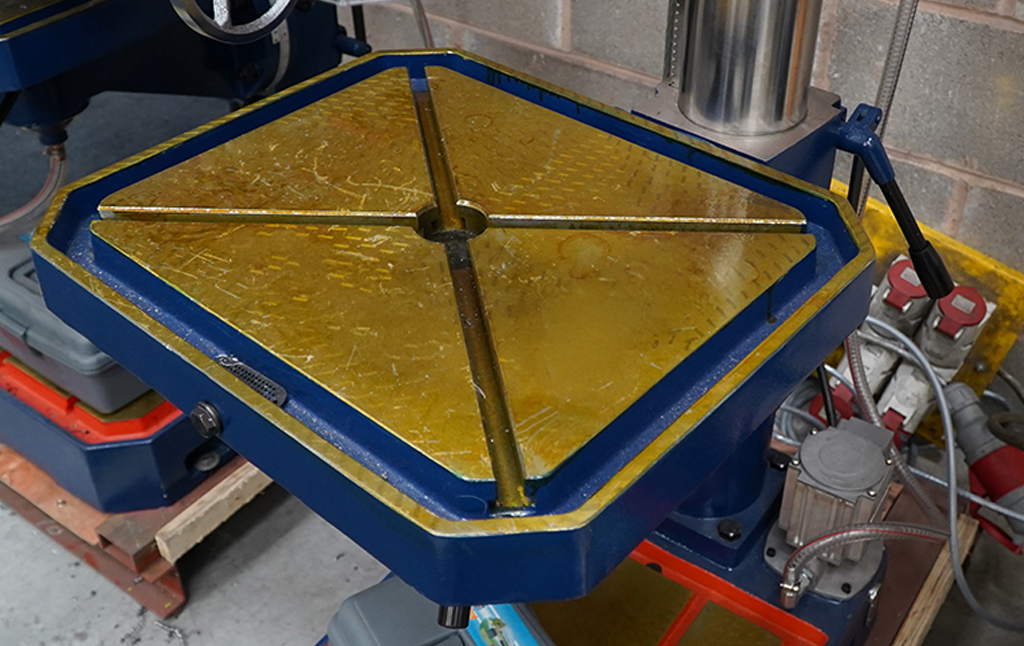
Check table dimensions and adjustment as well. Long sections may need external support, while a smaller part might need a vice that uses more space than expected. The work must be clamped securely; do not plan around holding it by hand.
The simplest way to shortlist a machine is to send Selmach a part drawing with the hole sizes, hole positions and material, plus your expected batch volume. Our industrial pillar drill buyer’s guide brings those checks together, and you can contact our team to discuss your application.
Published 30th September 2026