SHEET METAL

GUILLOTINE SHEARS

Sheet metal guillotines remain an essential part of modern fabrication, giving workshops a fast, accurate and dependable way to cut sheet and plate to size. Selmach supplies a comprehensive range of Morgan Rushworth mechanical, hydraulic swing beam and variable rake guillotines for manufacturers across the UK, with options suitable for light-gauge sheet through to heavier-duty production requirements.

With over 150 years of experience, Morgan Rushworth has been building shears since its inception, bringing a long-standing heritage of engineering expertise to every machine. Each machine is supported by our experienced engineering team, helping you select the right cutting length, material capacity, control system and handling options for your workflow.
Shearing Thickness
Shear Up To
25mm
Thick
Maximum Cutting Width
Up To
6m
Shearing Width
Backgauge
Up To
1,000mm
Powered Backgauge
Optional Extras
Optional Front
Light Guards
Safety System
150 YEARS OF EXCELLENCE

MORGAN RUSHWORTH HAS AN
ENVIABLE HERITAGE.

Morgan Rushworth has been at the heart of British manufacturing since 1872. Today, we continue that legacy with advanced CNC fibre laser technology built for the modern world.

1872
Rushworth & Co Established
A historic British engineering machinery name, established during the growth of UK manufacturing.
1972
Joining Forces
A.J.Morgan & Sons (Est. 1906) merges with Rushworth & Co to establish Morgan Rushworth.
Today
Advanced technology
The range of Guillotine machinery is built on over 150 years of experiene, where customer satisfaction and exceptional service are key.

CHOOSE YOUR GUILLOTINE SHEAR SOLUTION

Use these filters to explore our range, and narrow down the selection that best suits your requirement.

Not sure what you need? Speak to a specialist today.

Select the required cutting length. Each result represents a guillotine range containing at least one model within the selected length category.
Cutting capacity refers to the available mild steel cutting thicknesses within each guillotine range. Capacity for stainless steel and other materials will differ.
Choose between fast mechanical operation, versatile hydraulic swing beam cutting or heavy-duty hydraulic variable rake technology.
Morgan Rushworth RGMS Mechanical NC Guillotine Fast Cutting

RGMS Mechanical NC Guillotine

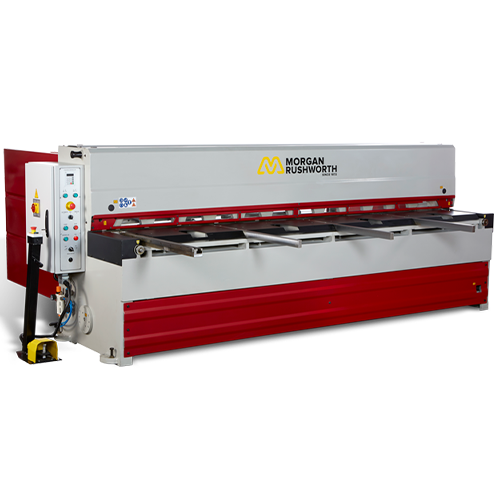
The Morgan Rushworth RGMS range of mechanical guillotines provides fast and accurate cutting of mild steel up to 4mm in thickness.

3,050mm
Max. Cutting Length
4mm
Max. Mild Steel
Mechanical
Swing Beam
NC
Backgauge Control
View Machine →
Morgan Rushworth HSGS Hydraulic Swing Beam NC Guillotine Most Popular

HSGS Hydraulic Swing Beam NC Guillotine

The HSGS range comes equipped with durable stainless steel cutting blades as standard, ensuring reliable performance and longevity.

4,060mm
Max. Cutting Length
8mm
Max. Mild Steel
Hydraulic
Swing Beam
NC
Backgauge Control
View Machine →
Morgan Rushworth BHGS Hydraulic Swing Beam NC Guillotine High Capacity

BHGS Hydraulic Swing Beam NC Guillotine

The powerful BHGS range of hydraulic swing beam sheet metal guillotines features a high visibility fixed front guard with windows for a clear view of the cutting area.

4,060mm
Max. Cutting Length
20mm
Max. Mild Steel
Hydraulic
Swing Beam
NC
Backgauge Control
View Machine →
Morgan Rushworth HSVS Hydraulic Variable Rake CNC Guillotine CNC Control

HSVS Hydraulic Variable Rake CNC Guillotine

The Morgan Rushworth HSVS variable rake guillotines are robust, heavy-duty machines built for reliability and performance when cutting mild steel up to 25mm thick.

6,070mm
Max. Cutting Length
25mm
Max. Mild Steel
Hydraulic
Variable Rake
CNC
Backgauge Control
View Machine →
No guillotine machines match the selected filters. Please adjust your selections or reset the filters to view the full range.

Industry Applications

NOT JUST CUTTING

COMPLETE THE PROCESS.

A guillotine is often only the first stage of sheet metal production. Once parts have been cut accurately to size, a press brake allows them to be folded and formed into finished components.

Pair a Morgan Rushworth guillotine with one of our CNC press brakes to create a complete cutting and bending setup, with capacities matched to your materials, component sizes and production requirements.

Why choose Morgan Rushworth?

Laser Power
UK-BASED SUPPORT
Local service, installation and training from our expert team.
Maximum Cutting Length
HERITAGE
AND TRUST
Over 150 years of engineering excellence you can rely on.
Automated Production
PREMIUM COMPONENTS
Using leading global brands for reliability and performance.
Automated Production
BUILT TO PERFORM
Robust machines designed for precision and productivity.

HELPING YOU TO DECIDE – GUILLOTINE BUYING GUIDE

With the range of Guillotines available, it can be difficult to know what option is the best for your needs. We’ve put together a Guillotine buyers guide to help narrow down the choices for you. Whether you’re cutting 1mm or 25mm, we’ve got a solution to suit your needs.

Mechanical, Hydraulic Swing Beam or Variable Rake?

The first decision is whether your work is best suited to a mechanical, hydraulic swing beam or hydraulic variable rake guillotine.

Mechanical guillotines are a strong choice for workshops cutting lighter-gauge sheet in regular production. Their relatively simple operating principle provides fast, dependable cutting, with the Morgan Rushworth RGMS range offering capacities up to 4mm mild steel. This makes them particularly suitable where cutting speed, simplicity and straightforward operation are the priorities.

Hydraulic swing beam guillotines provide greater cutting power and a broader choice of capacities. The HSGS is the most commonly selected Morgan Rushworth guillotine for general sheet metal fabrication, with capacities up to 8mm mild steel. The heavier-duty BHGS extends the same swing beam principle to capacities of up to 20mm.

For the most demanding applications, the HSVS hydraulic variable rake guillotine provides automated control over the cutting angle, blade gap, backgauge and stroke. Adjusting the rake angle to suit the material can help reduce twisting and improve cut quality, particularly when processing a wide variety of material thicknesses or cutting narrow strips.

Matching the Guillotine to Your Sheet Sizes and Materials

Begin with the largest sheet width and maximum material thickness you expect to process. The guillotine’s cutting length must accommodate the full width of the sheet, while its cutting capacity must be suitable for the material grade and thickness.

Do not base the decision solely on the work currently passing through your workshop. Consider whether upcoming contracts, larger components or a move into thicker materials could require additional capacity. A sensible amount of spare capacity can help futureproof the investment, although significantly overspecifying the machine may increase its cost, size and power requirements unnecessarily.

Published capacities are commonly based on a specified mild steel tensile strength. Stainless steel, high-strength steel, aluminium and other materials behave differently, so a machine described as having an 8mm mild steel capacity will not necessarily cut 8mm in every material. Broadly speaking, as a rule of thumb you can take off 1/3 of the capacity for Stainless Steel, or add on 1/3 more capacity for Aluminium. Provide us with the material type, grade, thickness and maximum sheet size so that the appropriate model can be confirmed.

The current Morgan Rushworth range covers cutting lengths from compact 1,350mm machines through to HSVS variable rake guillotines with cutting lengths exceeding 6,000mm

Blade Gap, Rake Angle and Avoiding Shearing Defects

A correctly specified guillotine should produce a clean, consistent edge, but the machine settings must still be matched to the material being processed.

Blade gap is the clearance between the upper and lower blades. It must be adjusted according to the material type and thickness. Incorrect clearance can contribute to excessive burr, poor edge quality, premature blade wear and unnecessary deformation.

The cutting or rake angle also affects the forces placed on the sheet. A swing beam guillotine uses a predetermined cutting geometry, while a variable rake machine allows the angle to be adjusted. Reducing the rake angle can help limit distortion when cutting thinner materials or narrow strips, while a greater angle can reduce the cutting force required for thicker plate.

Common shearing defects include:

  • Poor or heavily burred edges
  • Bowing across the length of the cut part
  • Twisting of narrow strips
  • Crooking or loss of straightness
  • Marks caused by worn blades or incorrect material support

Blade condition, blade gap, rake angle, material support and hold-down pressure can all influence the finished result. Regular inspection and correct setup are therefore as important as selecting the machine itself.

Choosing the Right Backgauge and Level of Automation

The backgauge positions the sheet behind the cutting line and determines the finished width of the cut component. The most suitable control system depends on the variety of work, production volume and frequency of repeat jobs.

A manually positioned backgauge can be sufficient for occasional cutting, simple work and smaller production quantities. It provides a straightforward and cost-effective arrangement, although positioning and checking dimensions require more operator involvement.

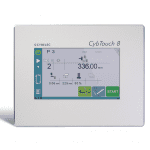
An NC-controlled backgauge automatically moves to the programmed position. This improves repeatability, reduces setup time and is particularly useful when cutting batches of identical parts. Controllers such as the CybTouch 8 can store cutting lists containing the required dimensions and quantities, helping the operator move efficiently through multi-stage jobs.

The HSVS uses a CybTouch 12 CNC controller to manage the backgauge alongside blade gap, stroke length and cutting angle. This higher level of automation is valuable where a workshop processes frequently changing materials, complex cutting lists or high production volumes.

Options That Improve Accuracy, Handling and Productivity

The right optional equipment can have a considerable effect on how quickly, safely and consistently a guillotine can be used. The most valuable options will depend on the sheet sizes, material thicknesses and production quantities involved.

A pneumatic rear sheet support helps support the material before the cut, reducing sagging and helping cut components remain controlled as they move towards the blade. This can be particularly useful for large, thin or flexible sheets.

Powered blade gap adjustment speeds up machine setup when regularly moving between different material thicknesses. On advanced CNC machines, the required gap can be calculated and positioned automatically as part of the cutting programme.

Other useful options can include:

  • Longer squaring arms for positioning large sheets
  • Additional front support arms
  • Ball-transfer tables for easier material movement
  • Angle gauges for angled cuts
  • Laser or illuminated cutting lines
  • Increased backgauge travel
  • Front light guards or lift-up finger guards
  • Tee slots, measuring rules and flip stops
  • Anti-twist systems for demanding narrow-strip work

Options should be chosen around genuine production requirements rather than added automatically. A workshop cutting occasional small blanks will have very different handling requirements from one processing full sheets throughout the day.

Workshop Space, Material Handling and the Complete Cutting Process

The physical length of the machine is only one part of the space required for a guillotine installation. Allow sufficient room in front of the machine for loading full sheets, behind it for the backgauge and cut material, and around the safety system for secure operator access.

The site assessment should consider:

  • Machine footprint and operating area
  • Front and rear sheet clearance
  • Delivery and installation access
  • Floor suitability and machine weight
  • Electrical supply
  • Safe material storage
  • Lifting and sheet-handling equipment
  • Space for completed parts and offcuts
  • Operator training and maintenance access

It is also worth considering what happens immediately before and after the guillotine. Many fabrication workshops pair a guillotine with a press brake, allowing flat sheet to be cut into blanks and then folded into finished components. Matching the working widths and material capacities of the two machines can create a more efficient cutting and bending process.

This approach has been used successfully by Selmach customers including S.W. Asgood Engineering, which invested in a guillotine and press brake and subsequently reported a 20% increase in production. Teknoroof also selected a three-metre guillotine and three-metre press brake as part of an expansion into thicker materials and additional products.

Our range of machines are well suited to different use cases – explore the range:

We offer a selection of Guillotines, whether your looking to have a fast cutting mechanical machine for thin materials, or need a high capacity CNC Variable Rake machine for a wide range of thicknesses and small parts.

The Morgan Rushworth RGMS is a fast and dependable mechanical swing beam guillotine designed for cutting mild steel up to 4mm thick. Available with cutting lengths up to 3,050mm, the range combines straightforward mechanical operation with an Elgo NC-controlled backgauge for accurate, repeatable positioning.

The RGMS is ideally suited to general fabrication workshops, roofing and cladding businesses, educational facilities and manufacturers regularly processing lighter-gauge sheet. Its rapid cutting cycle and relatively simple operation make it a practical choice where productivity, reliability and ease of use are more important than heavy-duty cutting capacity.

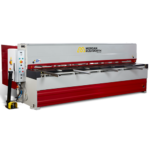
MR RGMS
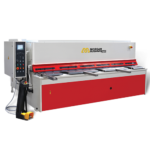
MR HSGS

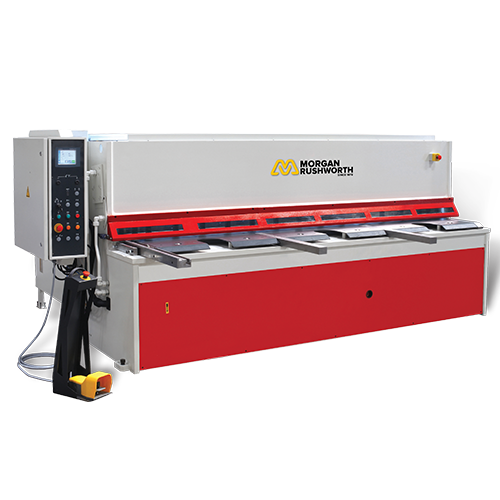
The HSGS is the most commonly selected Morgan Rushworth guillotine, providing hydraulic swing beam cutting for mild steel thicknesses up to 8mm. With cutting lengths reaching 4,060mm and a CybTouch 8 NC controller, it offers a strong balance of capacity, control and everyday production performance.

This range is well suited to general sheet metal fabrication, engineering workshops and manufacturers processing a mixture of component sizes and material thicknesses. It is a versatile choice for businesses that require more capacity and automation than a mechanical guillotine, without needing the heavier construction of the BHGS or advanced variable rake control of the HSVS.

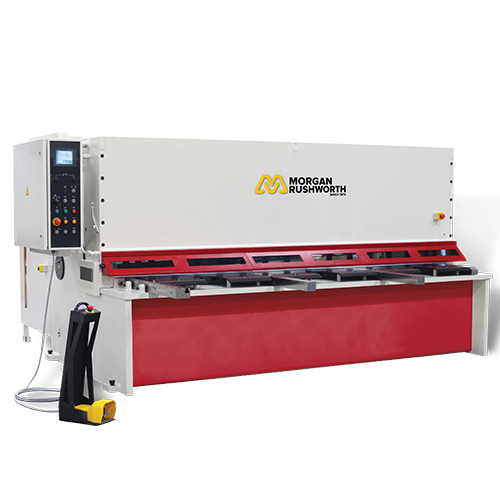
The Morgan Rushworth BHGS extends the hydraulic swing beam format into heavier-duty cutting applications, with models capable of processing mild steel up to 20mm thick. Cutting lengths are available up to 4,060mm, while the CybTouch 8 NC controller manages the powered backgauge and supports efficient repeat production.

The BHGS is intended for demanding fabrication and engineering environments processing thicker sheet and plate on a regular basis. It is particularly suitable for structural fabrication, heavy machinery manufacture and subcontract engineering businesses that require substantial cutting power but prefer the simplicity and established performance of a swing beam design.

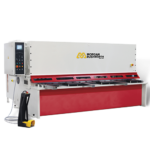
MR BHGS
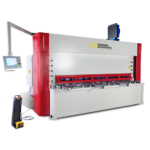
MR HSVS

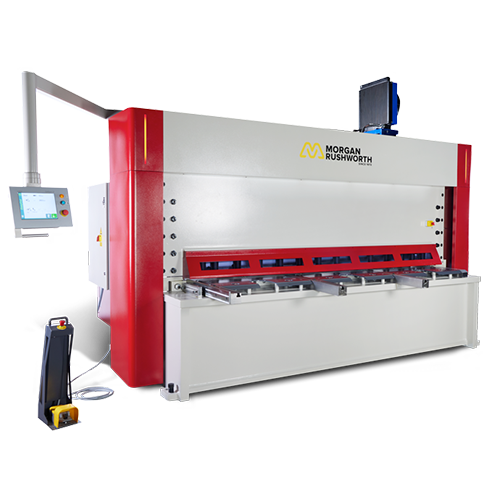
The HSVS is the most advanced and highest-capacity guillotine in the Morgan Rushworth range. Its hydraulic variable rake design is available with cutting lengths up to 6,070mm and mild steel capacities reaching 25mm, making it suitable for exceptionally large and demanding cutting requirements.

The CybTouch 12 CNC control automatically manages the backgauge, blade gap, cutting angle and stroke length to suit the programmed material and job. This makes the HSVS ideal for high-output manufacturers, heavy fabrication businesses and subcontractors processing a wide variety of material thicknesses, particularly where reduced distortion, automated setup and consistent cut quality are essential.

FREQUENTLY ASKED QUESTIONS

Fast, Straight Cutting of Sheet and Plate

A sheet metal guillotine uses an upper and lower blade to shear sheet or plate into accurately sized, straight-sided blanks. These parts can then move on to bending, rolling, punching, welding or other fabrication processes.

Guillotines are particularly effective for fast, repeatable straight cuts where curved edges, holes or complex profiles are not required.

Comparing Mechanical and Hydraulic Cutting Systems

A mechanical guillotine uses a motor-driven cutting mechanism and is generally suited to rapid production involving lighter-gauge materials. The Morgan Rushworth RGMS range cuts mild steel up to 4mm thick, making it a practical choice for straightforward and repetitive cutting work.

A hydraulic guillotine uses hydraulic power to operate the cutting beam and material hold-downs. Hydraulic machines offer greater cutting capacities and can incorporate more advanced backgauges, controls and sheet-support systems with the tradeoff being a slower cutting speed.

Fixed Cutting Geometry Versus Adjustable Rake

A swing beam guillotine moves the upper blade through a fixed arc. This established design provides reliable performance and a cost-effective solution for a wide range of general sheet metal fabrication work.

A variable rake guillotine allows the cutting angle to be adjusted according to the material type and thickness. This provides greater setup flexibility and can help reduce distortion when cutting thinner materials or narrow strips.

The HSGS for General Fabrication

The HSGS hydraulic swing beam range is the most commonly selected Morgan Rushworth guillotine for general sheet metal fabrication. It combines hydraulic operation, NC backgauge control and mild steel cutting capacities of up to 8mm.

Lighter work may be better suited to the mechanical RGMS, while the BHGS and HSVS ranges provide the additional capacity and control required for heavier-duty applications.

Match the Machine to Your Maximum Sheet Width

Choose a guillotine that can accommodate the widest sheet or longest straight cut you expect to process. A workshop regularly cutting 3,000mm-wide sheets should therefore select a machine with a nominal cutting length slightly greater than 3,000mm.

Consider potential future contracts as well as your current workload. However, a longer machine will also require more workshop space and suitable equipment for loading, supporting and moving larger sheets.

Cutting Different Materials and Preventing Cross-Contamination

es, provided the machine capacity, blade specification and setup are suitable for the material. Morgan Rushworth hydraulic guillotines can be configured to process mild steel, stainless steel, aluminium and other commonly fabricated metals. The maximum allowable thickness will vary between materials, so the intended grades and thicknesses should be confirmed when the machine is specified.

Where mild steel and stainless steel are processed on the same machine, suitable cleaning and handling procedures should be followed. Carbon steel particles transferred from blades, support tables, tooling, grinding dust or general handling can become embedded in the stainless steel surface and later produce rust staining. Workshops carrying out critical stainless steel work may therefore use dedicated equipment, or carefully clean the blades, bed, supports and surrounding area before changing materials.

I would avoid suggesting that contamination is inevitable. The better message is that mixed-material cutting is possible, but the risk needs to be managed properly.

Cutting Capacity Depends on Material Strength

No. Published cutting capacities are normally based on mild steel with a specified tensile strength. Stainless steel and high-strength materials require more cutting force, while aluminium and softer metals behave differently during shearing. As a very rough rule of thumb, you can deduct a third capacity for Stainless Steel, and add a third more capacity for aluminium.

The material grade, tensile strength and maximum thickness should always be confirmed when specifying the machine. This allows Selmach to recommend the correct guillotine rather than relying on a nominal mild steel capacity alone.

Accurate Positioning for Repeatable Parts

The backgauge positions the rear edge of the sheet at a measured distance from the cutting line. This determines the finished width of the cut component and allows repeated parts to be produced consistently.

Powered NC and CNC backgauges move automatically to programmed positions. This reduces manual measuring, shortens setup times and improves repeatability across production batches.

Choosing the Right Level of Automation

An NC controller typically manages functions such as backgauge positioning, cut dimensions and production quantities. It is well suited to repeat batches, cutting lists and general production work.

A CNC-controlled guillotine can manage additional machine settings. On the Morgan Rushworth HSVS, the controller automatically manages the backgauge, blade gap, cutting angle and stroke, reducing the amount of manual setup required between jobs.

Maintaining Cut Quality and Blade Life

Blade gap is the clearance between the upper and lower cutting blades. The correct clearance depends on the material type and thickness being processed.

An incorrect blade gap can produce excessive burr, poor edge quality, material deformation and accelerated blade wear. The setting should therefore be checked whenever the material specification changes significantly.

Understanding Common Shearing Defects

Twisting and bowing can be caused by an unsuitable rake angle, incorrect blade gap, worn blades, insufficient sheet support or the dimensions of the finished component.

Narrow strips are particularly vulnerable to distortion. Variable rake control, pneumatic sheet support and anti-twist systems can help where this type of work is regularly undertaken.

Blade Maintenance Depends on the Workload

Blade life depends on the material being cut, its thickness, production volume, blade clearance and the condition of the machine setup. Abrasive or high-strength materials may shorten the period between maintenance.

Many Morgan Rushworth guillotines use blades with multiple cutting edges. These can be rotated to expose a fresh edge before the blade needs to be sharpened or replaced.

Improving the Handling of Large or Flexible Sheets

Pneumatic sheet support is particularly useful when processing large, thin or flexible sheets. It supports the material while the backgauge positions it, helping to prevent sagging before the cut takes place.

This can reduce operator effort, improve handling and help maintain cutting accuracy during repetitive production. It can also provide a more controlled method of directing finished components to the front or rear of the machine, depending on the selected system.

Producing Tapered Blanks and Angled Edges

Yes. An angle gauge, squaring arm or suitable front measuring system can be used to position the sheet at an angle to the cutting blade.

The guillotine will still produce a straight cutting line, making it suitable for tapered blanks and angled edges. Curved or more complex profiles will require a different cutting process.

Creating a Compatible Cutting and Bending Setup

The working widths do not have to match exactly, but compatible capacities can simplify the movement of components between cutting and bending.

For example, pairing a three-metre guillotine with a three-metre press brake creates a practical setup for cutting and folding parts from standard three-metre sheets. The press brake tonnage must still be calculated from the material, thickness, bend length and tooling rather than selected by working width alone.

Support From Specification to Production

Selmach can assess your application, recommend the appropriate guillotine and support the installation and commissioning process. This includes considering workshop access, electrical requirements, machine positioning and safe operating clearances.

Operator training, servicing and ongoing technical support can also be included, helping your team use the machine safely and productively from the beginning.

READY TO ADD TO YOUR SHEARING CAPABILITIES?

Whether you are replacing an existing guillotine, increasing your cutting capacity, or investing in a complete cutting and bending setup, our fabrication specialists can help identify the ideal Morgan Rushworth solution for your materials, sheet sizes, production requirements and long-term manufacturing goals.

UK Installation • Training • Service Support • Finance Available

See the machines in action

    Request A Quote

    Your Name *

    Email *

    Postcode *

    Company Name *

    Telephone No. *

    Where did you hear about us?

    Your Message

    Specific model / specification?

    Tick to join our mailing list and receive special offers, machinery and industry news articles. You can unsubscribe at any time.


    Your information will be held according to our privacy policy.

    UK Flag
    Alternatively call +44 (0)1432 346 580 for sales and support

    Secret Link