
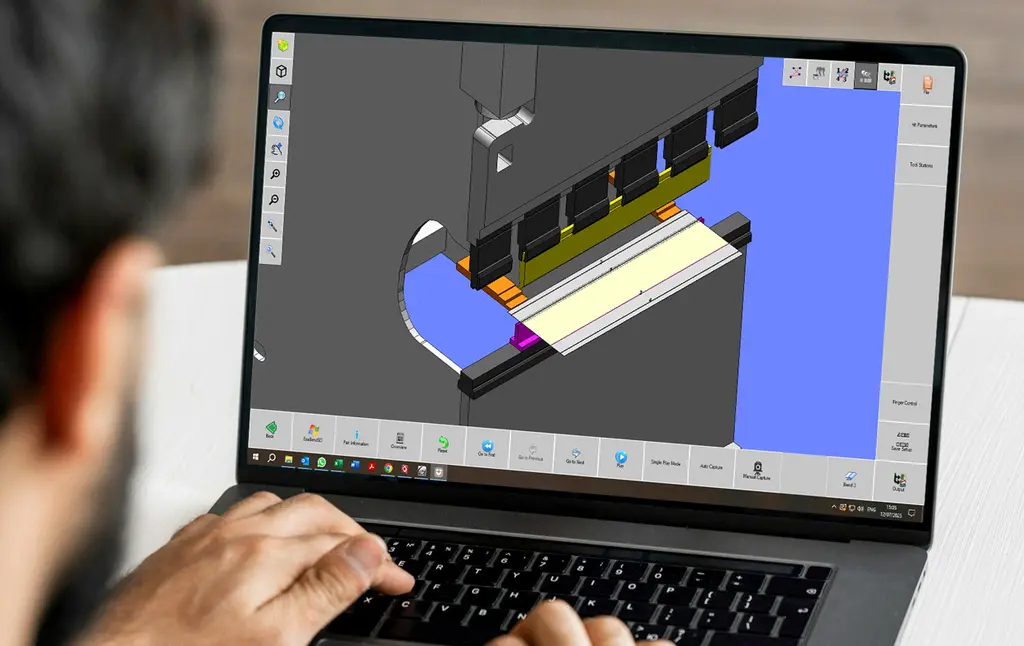
A press brake capable of bending a flat blank may not be able to complete the finished component. Boxes, channels and return flanges introduce access and handling requirements that should be checked before selecting a machine.
Assess the component through its whole sequence
Start with the folded drawing and, where possible, a STEP model. Identify every bend, the intermediate shape and how the operator presents the part. Check loading, rotation and finished-part removal as well as the bending positions.
For a box, wall height and returns influence punch access and the room available around the ram. For a U-channel, the second flange may interfere with the punch or machine. A C-section adds returns that can restrict gauging and the order of bends.
Dimensions to check together
Daylight is the opening available with the ram raised, while stroke describes ram travel. Tool heights consume part of that space. Throat depth and distance between columns can restrict the partly formed component. Nominal working length alone does not describe this envelope.
List web width, flange heights, return lengths, radii, angles, holes, notches and tolerances. State how dimensions are measured on the drawing. A short return or nearby hole can affect the practical forming method.
Tooling and gauging
Gooseneck or segmented tools may provide access, subject to their dimensions and loading limits. Special offset or hemming tools may be needed. The backgauge must reference the part consistently at each bend without obstructing it. Extra axes help only where they address those movements.
Use the tooling and backgauge guides for the detailed choices. The application assessment brings them together on one actual part.
Consider the production mix
A conventional CNC press brake can be a flexible route for varied parts. Automatic tool changing may be valuable where repeated tool changes dominate setup. A panel bender may deserve comparison for suitable panel families, but should not be assumed to form every enclosed box. For the PBXS configuration discussed below, distinguish the optional hydraulic-release clamping from an automatic tool changer: clamping releases and secures tooling rather than exchanging tools.
Compare complete accepted-part cycles, including setup and handling, rather than a single ram stroke. Ask suppliers to prove your geometry on the quoted configuration.
Assessing Morgan Rushworth PBXS
Selmach’s premium PBXS range is a candidate for an assessment where configurable hydraulic capacity, tooling and gauging are needed. Suitability depends on the selected model and options. Send the deepest box, narrowest channel and most awkward return alongside a typical production component.
Ask Selmach to confirm the proposed bend sequence, clearance, tooling schedule, control package and handling arrangement. Request a drawing-based quotation and a demonstration covering the full route to an accepted component.
What to send
Provide material grade and thickness, maximum length, folded drawings, available CAD, finish requirements and batch sizes. Highlight critical tolerances and any existing tools you want to reuse. This allows the machine to be specified around the work rather than a generic description such as complex bending.
Published 21st October 2026