
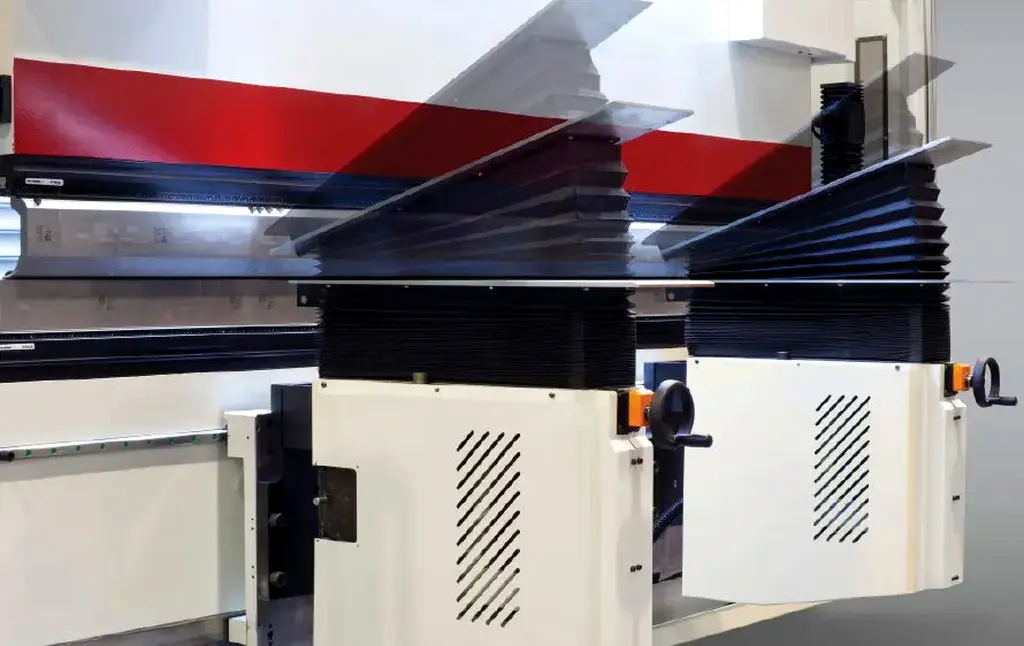
Heavy-component bending involves several different handling tasks: loading the blank, positioning it, supporting it during forming, turning it and removing the finished part. One accessory may not address them all. Assess the complete route before selecting the press brake and support package.
Fixed supports and powered followers
Front arms, rollers or ball-transfer surfaces can assist presentation and positioning. Powered sheet followers move with the component during forming where the system is designed and configured for it. These are different functions and should not be described interchangeably.
A published load figure needs its conditions. Confirm whether it applies per arm or to the whole system, the permitted centre of gravity and moment, component dimensions, travel and operating restrictions. Total component weight alone does not establish suitability.
Loading and turning
A crane, vacuum lifter, magnetic system or manipulator may assist loading and transfer. Its suitability depends on the material, surface, geometry and equipment rating. A lifting device that works well on a flat blank may not be suitable for a partly formed component.
Discuss controlled turning and removal as part of the application. Do not assume a suspended load can be used through the bending cycle without an engineered arrangement.
Assess machine integration
Followers must be compatible with the machine geometry, tooling, controller and safeguarding. Establish who takes responsibility for integration, commissioning and the complete operating method. Retrofit feasibility must be confirmed for the actual machine.
For repeat component families, investigate automation only after checking payload, gripping, reach, collision clearance and the full sequence. High weight does not automatically justify a robotic cell.
Specify the PBXS handling package
Selmach’s PBXS page presents optional CNC-controlled sheet follower arms. Ask for model-specific compatibility, rated capacity and operating limits before treating them as suitable for a particular part. The premium PBXS package should be assessed with the intended tools and component sequence.
Provide blank and finished dimensions, weight, centre-of-gravity information where available, steel grade, thickness and bend sequence. Describe the current lifting and turning tasks and where operators need assistance.
Prove the complete process
Demonstrate your heaviest awkward component and a representative repeat job. Record handling time, operator interventions, support through forming and removal. Assess the work method and operator training with the supplier.
Use the existing Selmach squaring-arm article for that particular accessory and the tandem guide for unusually long work. For the complete machine-and-handling assessment, send drawings and production requirements to Selmach and request an integrated PBXS proposal.
Published 21st October 2026