
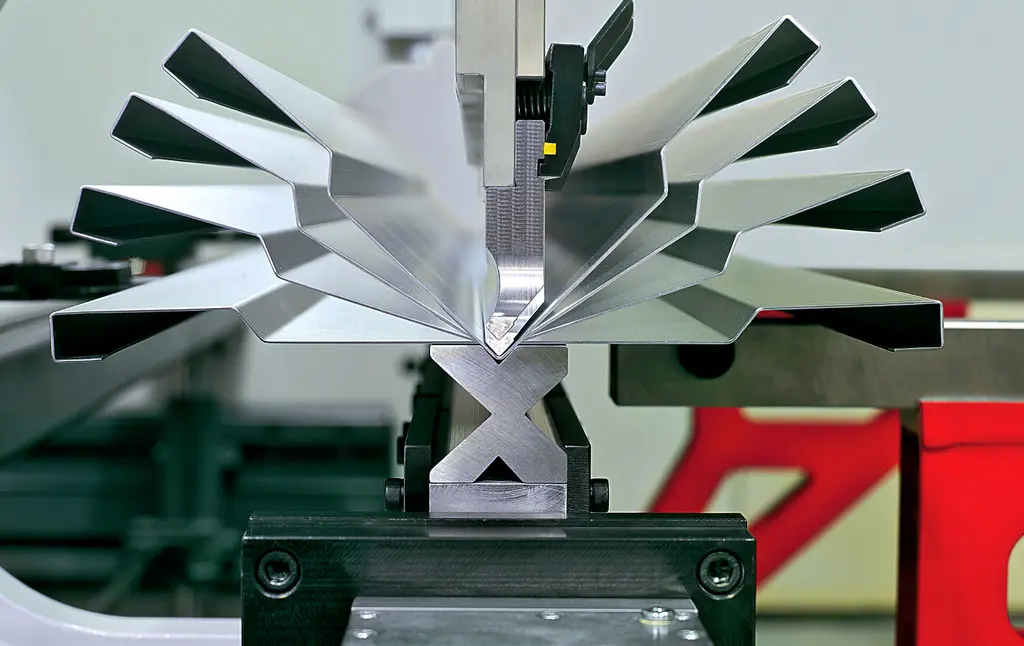
Stainless steel components often combine dimensional requirements with visible surfaces. A suitable press brake is only one part of achieving both. Material grade, tooling and the inspection method need to be included in the selection.
Specify the actual material
Identify grade, thickness range and available strength data. State the finish, grain direction where relevant and whether protective film is present. Material from different batches can behave differently, so a repeat programme may still need an approved first-off check.
Avoid applying a mild-steel force assumption to stainless without adjustment. Have the supplier calculate the forming requirement for the material and tools being considered.
Plan springback and radius
The required angle after unloading depends on material behaviour and the forming setup. Assess the desired radius, minimum flange and tooling opening together. Specify any angle-measurement option by its actual capabilities and restrictions rather than assuming it eliminates all variation.
Agree the finish standard
Identify which surfaces are cosmetic and what marks are acceptable. Clean, suitable tools and compatible protective solutions may reduce marking, but they must be trialled on the actual material and geometry. Film, inserts or roller solutions are not universal remedies.
Include preparation and handling in the trial. Damage introduced while stacking or turning can be mistaken for a bending-tool problem.
Check long and complex parts
For a long bend, measure angle consistency at agreed positions. For a multi-bend component, check finger access, returns, tooling clearance and removal. Confirm flange dimensions and overall assembly fit as well as the individual angle.
Assess PBXS for the application
Morgan Rushworth PBXS is Selmach’s premium CNC hydraulic range. Discuss a configuration covering capacity, gauging, crowning, controller, tooling and any suitable measurement options. Suitability should be established with your stainless component, not inferred from a generic thickness statement.
Send drawings, grade, thickness, maximum bend length, tolerances and finish requirements. Ask Selmach to trial a long panel and your most demanding return. Record first-off adjustments, accepted dimensions and surface results.
Use the press brake tooling and accuracy guides for the detailed assessment, then request a PBXS quotation covering the tested package.
Published 21st October 2026