
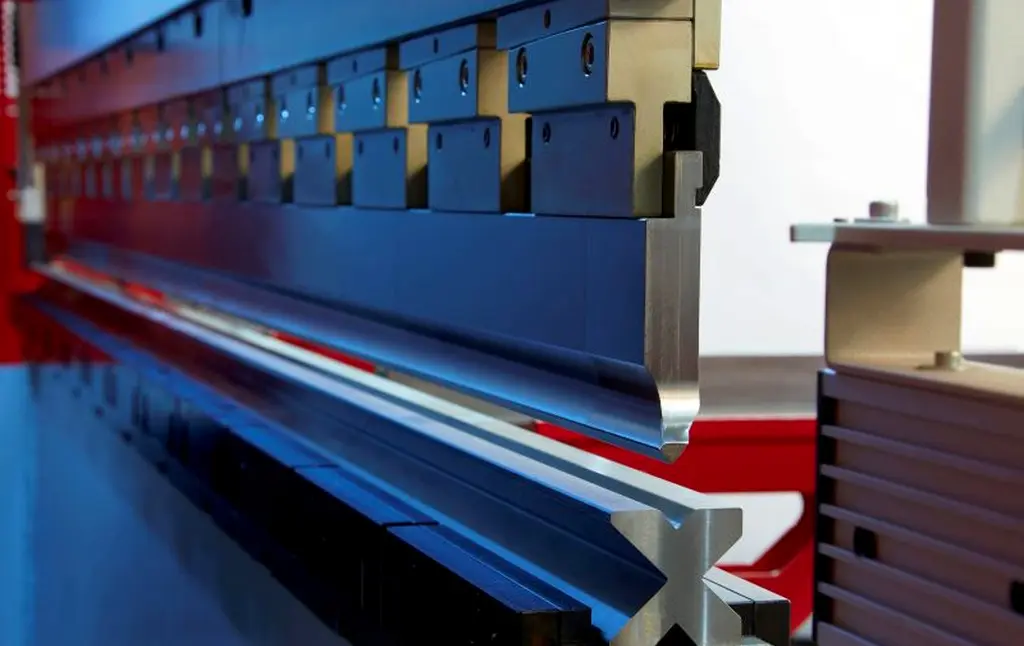

The tooling package determines which parts a press brake can form and how efficiently the operator can change jobs. Specify tools against a representative component set rather than accepting an unspecified starter package.
Match punch and die to the bend
The die opening influences force, radius and minimum flange support. The punch profile affects contact and clearance. A gooseneck punch can provide clearance for some returns, but its shape and load rating must suit the application. It does not guarantee that every deep box can be formed.
Hems, offsets and large radii may require a different tool arrangement or forming sequence. Discuss these parts before ordering so the quotation includes their requirements.
Check the forming envelope
Consider the partly formed component at every bend, including turning and removal. A flange may contact the punch body, clamp, ram, die, backgauge or frame. Daylight, stroke and throat depth must be assessed with the actual tool heights.
Segmented tooling can allow a box or return to be formed around a selected tool length. Check segment availability, safe insertion and removal, and how the arrangement is represented in the controller’s tool library.
Respect tooling load limits
Confirm allowable load per metre and any minimum loading length for each tool and holder. Machine tonnage is not a tooling rating. Adapters, clamps and specialist punches may impose additional restrictions. The quotation should identify the intended tools and their applicable limits.
Choose clamping around changeovers
Compare the included quick-release arrangement with any powered clamping option. Time a complete changeover using the tools your components need, including alignment, library selection and first-off verification. A faster clamp cannot remove all preparation time.
Confirm the tooling interface and compatibility with existing tools. Similar-looking systems are not automatically interchangeable.
Plan cosmetic work
For stainless steel or aluminium, identify visible surfaces and acceptable witness marks. Clean, suitable tooling and compatible protective solutions can help, but protection materials and alternative dies have application limits. Trial the actual finish and material.
Build the PBXS tooling schedule
The Morgan Rushworth PBXS is Selmach‘s premium CNC hydraulic range. Standard equipment includes Euro-style quick-release top tool holders, sectionalised gooseneck top tooling and a multi-V bottom die. Hydraulic-release top and bottom tooling clamping is optional. Ask for a tooling schedule matched to your brackets, channels, boxes and repeat components, with clamping and software-library scope clearly stated.
Send drawings, material details, radii, minimum flanges and batch sizes. Include the most difficult return and any appearance-critical parts. Use our V-opening guide for capacity considerations and the complex-components guide for bend access.
Existing setup and laser-guard videos should be followed only for the relevant machine and approved procedure. Tool purchasing guidance does not replace operator training or the machine instructions.
Published 21st October 2026