
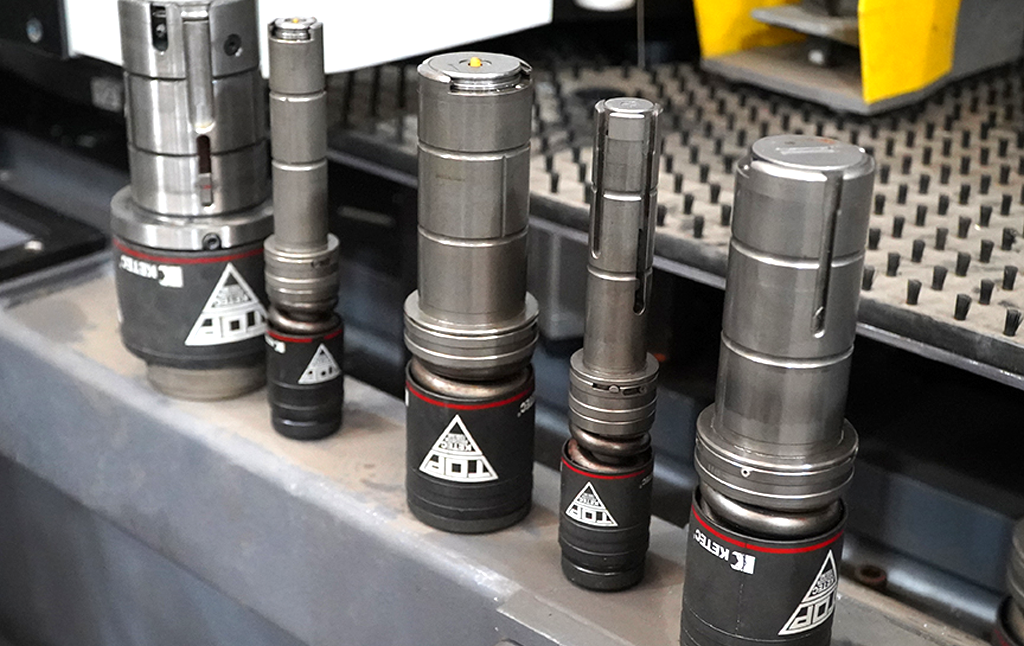
A turret punch press can carry a useful collection of tools ready for the next job. However, the number of stations is only the beginning of the story. The size of those stations, which ones can index and whether they accept multi-tools all influence what the machine can produce without a manual changeover.
For anyone comparing CNC turret punch presses, understanding these terms makes a specification table much more useful. It also helps avoid buying a large turret that is poorly matched to the parts you actually make.
What a turret station does
A turret station is a position for a tooling assembly. The machine rotates its upper and lower turrets to bring the required punch and matching die into the working position. The sheet then moves to the programmed coordinates for the operation.
Different stations accommodate different tool sizes. A large cut-out, a small round hole and a specialist forming feature do not necessarily use the same station type. The tool’s overall working envelope matters as well as the dimensions of the feature it produces.
Station count therefore needs to be read alongside the turret diagram. Ask how many positions accept the tools you need, rather than assuming that every position can carry any tool.
Turret rotation and auto indexing are different
Turret rotation selects the station. Auto indexing changes the angular orientation of a suitable tool at an indexable station, with the punch and die kept in the corresponding orientation.
Consider an obround slot required at several angles on a component. An indexable tool may produce those slots using one tool geometry at different programmed angles. Without the appropriate indexing arrangement, additional tooling or a different processing strategy may be needed.
This is why the number and size of indexable stations can be more important than a small difference in total station count. One job might use many fixed round tools; another might depend on several non-round tools that all need angular control.
Indexing is not a blanket promise that any tool can operate at any angle. The machine configuration, tooling and application limits must all support the intended use.
How a multi tool increases available tooling
A multi-tool places several smaller tools within one compatible carrier. The machine selects the required insert through the supported selection mechanism. This increases the number of tools available without adding the same number of physical turret stations.
The Morgan Rushworth TPH and TPS brochure gives a helpful example. Its 33-station layout includes three indexable D stations, with compatible multi-tool arrangements offering up to 54 tools. That is a configuration-dependent maximum, not a statement that every supplied machine arrives with 54 tools fitted.
For illustration, replacing the single tools in three stations with eight-tool carriers gives 30 remaining single tools plus 24 inserts: 54 tools in total. The three carriers occupy existing stations; their inserts are not added on top of 33 fully populated single-tool positions.
Selection within a multi-tool and angular indexing of an individual insert are also separate capabilities. Confirm what the proposed carrier can actually do, which insert sizes it accepts and what restrictions apply to the material and operation.
More tools can mean fewer changeovers
The benefit of carrying more tools is often most visible between jobs. A common set of round holes, slots and corner tools can remain available while several component programmes run in sequence.
Imagine a workshop with two recurring panel designs. Both use the same small round holes, but one adds a rectangular opening and the other uses an angled slot. If their complete tool requirements fit the available turret layout, the second job may not require the same manual tool changes as a more restricted setup.
That is an application example, not a guaranteed time saving. Programming, material changes, first-off inspection and any special forming setup still count. Leaving tools installed is valuable only when their condition and setup remain suitable for the next job.
Selmach’s GL Profiles customer story offers a historical example of a business valuing indexing and multi-tool versatility. It concerns a Baykal installation reported in 2018, rather than a current TPH or TPS installation, but the underlying buying consideration remains relevant: tooling flexibility needs to support the workshop’s real work.
Build a tool map before comparing machines
Take several typical drawings and make a combined tool list. Record the feature shape and size, material and thickness, station requirement, indexing requirement and whether a suitable tool is already owned.
Then separate the everyday tools from the occasional ones. A tool used on almost every job may justify a permanent turret position. A rarely used special form may be better assessed around planned batch changes, depending on production demand.
Ask the supplier to place the proposed tools on the actual turret diagram. This exposes restrictions that a headline station count cannot show, such as several large tools competing for a limited number of suitable positions.
The Morgan Rushworth TPM offers a 12-station arrangement, while the TPH and TPS provide larger turret configurations. The useful comparison is how each arrangement handles your tool map and changeover pattern.
Keep the software and physical setup in agreement
The CAM system needs an accurate record of the installed tools, their positions and any indexing or multi-tool restrictions. A programme based on an out-of-date turret setup is not a reliable production plan.
Use a controlled method for recording tool changes, approved settings and maintenance status. The operator should be able to verify that the physical setup matches the programme before the job is released.
Existing tools also need a proper compatibility assessment. A familiar station letter or tool-brand name does not confirm that the punch, guide, stripper, die, holder and length arrangement suit another press.
If you are specifying a new machine, send Selmach a representative tool list alongside your drawings. We can discuss the CNC punch range in terms of the operations and changeovers your workshop needs, rather than treating station count as the whole decision.
Published 1st October 2026