
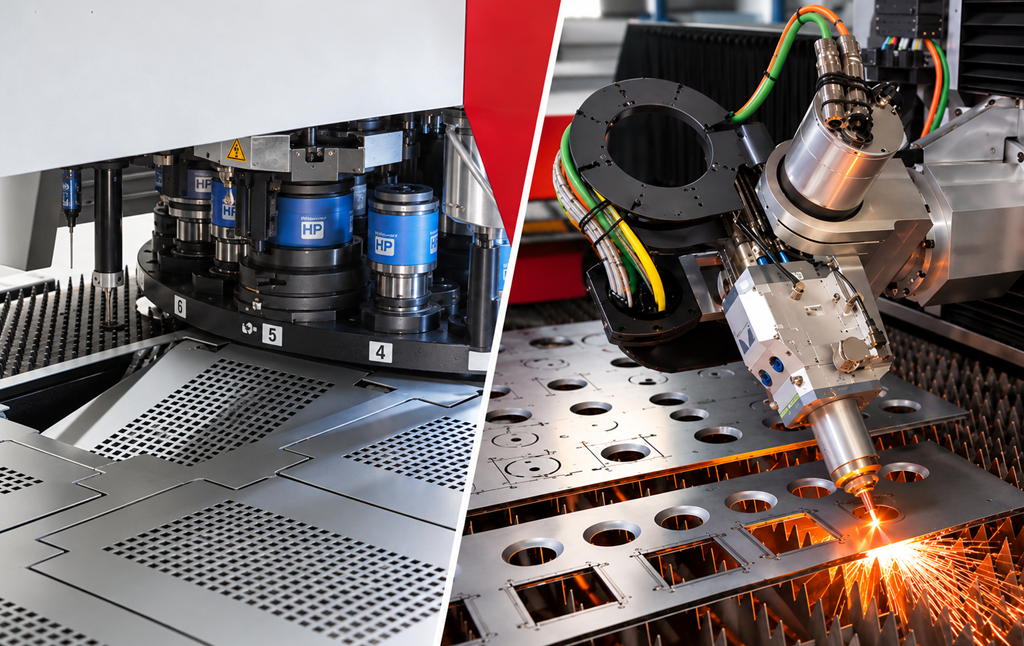
A CNC turret punch press and a fibre laser can both produce sheet metal components, but they earn their place in different ways. A punch uses dedicated tooling to create holes, cut-outs and formed features. A laser follows a programmed cutting path, giving considerable freedom when the outline or detail changes.
The useful comparison is therefore the cost and time required to produce an acceptable finished component. Looking only at the cutting stage can miss tooling changes, forming, handling and the work still waiting at the next machine.
For manufacturers comparing CNC punch presses with flat-bed fibre laser cutting machines, the starting point should be a representative selection of parts, rather than one particularly impressive demonstration.
Where a turret punch has an advantage
Repeated features are an obvious place to investigate punching. A panel containing rows of identical holes or slots can use the same tool repeatedly, without tracing the perimeter of each opening. Suitable cluster tooling can produce several features in a single stroke, although the combined force and tooling limits must be checked.
Punching becomes especially interesting when the component needs more than flat cut-outs. With the appropriate tooling and machine configuration, louvres, embossments, locating features and extrusions can be produced during the punching programme. A conventional flat-bed laser cannot create those three-dimensional features simply by cutting their outlines.
Consider a ventilation panel that needs fixing holes and formed louvres before bending. If a turret punch can complete both features, it may remove a separate forming operation and its associated handling. That is an application to test, not a guarantee that punching will be cheaper for every ventilation panel.
Where a fibre laser has an advantage
A laser is well worth considering when parts contain intricate profiles, frequent design changes or shapes that would require numerous special punches. Changing a CAD profile does not require a matching physical cutting tool, although the cutting parameters, material and quality requirements still need validation.
Punches can produce larger or irregular contours by nibbling with overlapping hits. However, this adds strokes and can leave a scalloped edge that needs further attention. A laser may provide a more practical route for such geometry, particularly when the edge will remain visible.
Material range matters too. A laser specified for thicker material can cover jobs outside a particular turret punch’s capacity. Neither process should be selected from a headline maximum thickness alone: hole size, material grade, edge requirements and the individual machine all affect the result.
Compare the features that matter to the job
| Production requirement | Turret punch considerations | Fibre laser considerations |
|---|---|---|
| Many repeated holes or slots | Reuses installed tools; cluster tooling may help | Assess piercing and cutting time for the complete pattern |
| Frequently changing outlines | Check tooling availability and nibbling time | Programmed contours offer flexibility without dedicated shape tooling |
| Louvres or raised features | May form them in the same programme | Normally requires another forming process |
| Visible external edges | Assess nibbling marks and burrs | Assess cut quality for the specified material and settings |
| Mixed sheet thicknesses | Check force, station and tooling restrictions | Check the proposed laser and assist-gas combination |
Compare cost per accepted part
Ask for a process route that starts with the supplied sheet and ends at the same stage of manufacture. If the laser quotation stops at a flat blank while the punch quotation includes forming, the figures are not directly comparable.
Include programming and setup, material yield, processing time, consumables, tooling provision and maintenance, unloading, deburring and any secondary operations. Divide the batch cost by the number of acceptable components, not simply the number started. Keep any machine-rate assumptions consistent, so labour or energy is not counted twice.
Batch size changes the picture. A dedicated tool may be difficult to justify for a handful of one-off components but attractive for a design that repeats regularly. Conversely, keeping an extensive tooling inventory has a cost even when individual jobs run quickly. Use realistic annual repeat quantities rather than the largest order you hope to win.
These are costing inputs, not a universal price comparison. A supplier trial and your own production records will be more useful than a generic claim that one technology is always cheaper.
Check the component after processing
Punching does not create a laser-cut heat-affected zone, but it can introduce mechanical deformation, burrs or surface marks. Fibre laser cutting can also require finishing, depending on the material, parameters and edge specification. Neither machine should be described as automatically producing distortion-free or finishing-free parts.
Inspect hole quality, flatness and the cosmetic face as well as overall dimensions. If the component will be folded, take the trial through the proposed press brake operation. A fast blank is of limited benefit if a fixing hole distorts during bending or a formed feature obstructs the next tool.
Sometimes the right answer is to use both
A workshop with both technologies can allocate different part families to each machine. It may also combine processes where forming and complex cutting are both required. Such a route needs planned datums, handling and clamping; moving an already cut or formed component between machines is not automatically straightforward.
There is no universal rule that laser cutting must come first or that punching must come first. The sequence depends on how the sheet remains supported and how later operations can locate it accurately.
Make the comparison using your own drawings
Choose a recurring component, a frequent changeover job and a part that currently needs secondary work. Supply the material grade, thickness, batch quantities, finish and tolerance requirements. Ask for a complete cycle and tooling plan, then inspect the finished samples.
Explore Selmach’s CNC turret punch press range and fibre laser range to identify suitable options. Send us the drawings and the production problem you want to solve, and we can discuss which route deserves a closer look.
Published 1st October 2026