
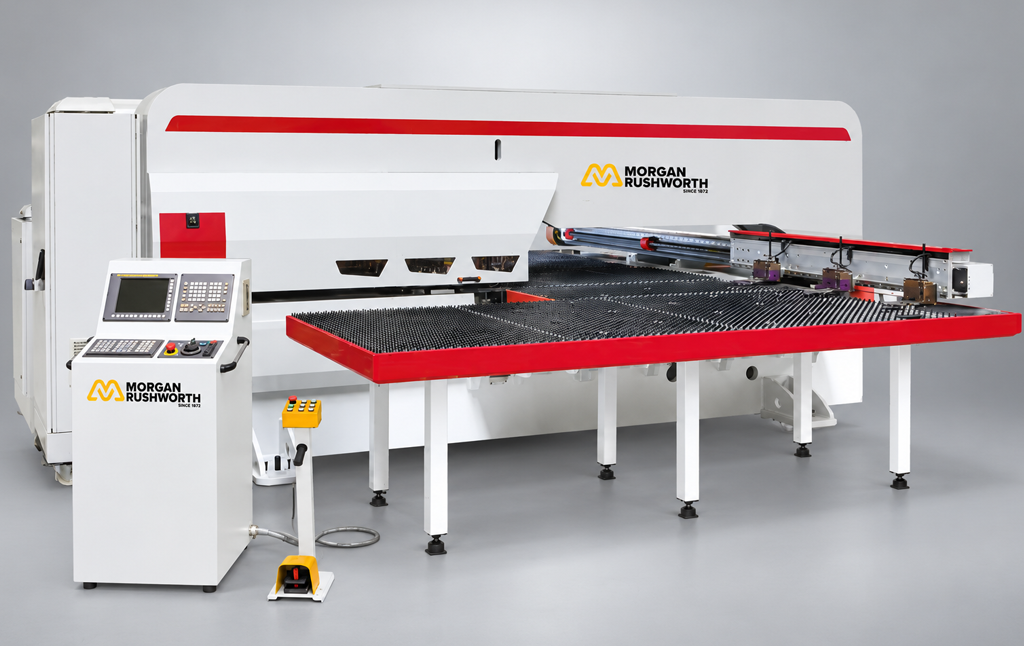
The right CNC punch press is the one that can produce your regular work economically while leaving sensible capacity for the jobs you expect next. Buying on tonnage, sheet size or stroke rate alone can overlook the features that determine whether a machine fits the workshop.
Start with a small collection of representative drawings. Include the material specifications, thicknesses, tolerances, batch sizes and repeat frequency. Add the operations currently carried out after punching, because those may reveal the strongest reason to change the process.
Selmach’s CNC punch press category includes four Morgan Rushworth product families: HSP, TPM, TPH and TPS. They should not be treated as four interchangeable versions of the same machine.
Choose the right type of punching machine first
The HSP is a CNC hydraulic plate-punching range, with a different working arrangement from a sheet-metal turret press. It is relevant to work such as repeated hole patterns in plates. Triple tooling is an option with its own thickness restrictions, not a full rotating sheet-metal turret.
The TPM, TPH and TPS are turret punch ranges. They carry multiple tools for different features and suit sheet components that need a combination of punching and, with suitable equipment, forming operations.
| Product family | Main distinction | What to assess first |
|---|---|---|
| HSP | CNC hydraulic plate punching | Plate geometry, hole patterns and tool configuration |
| TPM | Hydraulic turret press with 12 stations | Required tool mix, index stations and repeat jobs |
| TPH | Hydraulic turret range with 27 or 33 stations | Sheet format, force and installed tooling capacity |
| TPS | Servo-electric turret range with 27 or 33 stations | Punching duty cycle, stroke control and tooling capacity |
The table is a guide to the families, not a replacement for an application assessment. Available specifications and options should be confirmed for the machine quoted.
Separate force from thickness capacity
A tonnage rating describes available force. It does not mean the machine can punch every shape in every material up to a stated thickness.
The force needed increases with the cut perimeter, material thickness and material shear strength. A large hole therefore needs more force than a small hole in the same sheet. A cluster tool punching several holes at once must be assessed using the combined cutting requirement.
Other limits matter even when sufficient force is available. The individual station, punch dimensions, stripping requirements and tooling design may restrict the operation. A small punch in relatively thick material can be a tooling problem without exhausting the machine’s headline tonnage.
For example, the TPH and TPS tables specify their 88.9 mm maximum punch diameter on 1 mm sheet. That must not be combined with the separate maximum mild-steel thickness to imply an 88.9 mm hole through 6.35 mm material. Supply the actual hole sizes and thicknesses for verification.
Check the working area and sheet weight together
Compare your normal purchased sheet sizes with the machine’s direct working range. Then establish whether the proposed layout needs repositioning, where the clamps can hold the material and how the remaining sheet will be supported.
Repositioning can extend usable X-axis coverage on a suitable machine, but it does not create unlimited sheet capacity. Maximum sheet weight, access, support and the permitted repositioning arrangement still apply.
Ask for a nest of your typical components. A nominally larger machine may avoid an extra reposition or accept a more useful sheet format, but the benefit needs to appear in the actual production plan.
Examine the turret layout rather than just the station count
Count the tools a typical job needs, then identify which must be indexable and which require larger stations. A turret with spare small stations may still be unsuitable for a job requiring several large forming tools.
The TPM has a 12-station turret with three indexable stations and optional multi-tool arrangements. The TPH and TPS offer larger station configurations. Compare the usable tool arrangement for your work, not simply the largest number on the page.
Compare complete cycles and changeovers
Request a cycle estimate that includes tool selection, sheet travel, indexing, forming and repositioning. Separately record loading, unloading, tool setup and first-off inspection.
A machine that completes one part quickly may still lose time if each new job needs substantial setup. For a workshop producing mixed small batches, changeover performance can be more important than the highest published hit rate.
Give the supplier a repeat job and a typical changeover job. This makes it harder for a single favourable demonstration to conceal the demands of normal production.
Confirm software and training scope
The TPM product page lists Bosch MTX control and Lantek software. The TPH and TPS brochure specifies FANUC control and Metalix CAD/CAM. This is a practical distinction for programmers and operators, not a reason to assume one package is universally better.
Check which licences, post-processors, nesting functions and training are included. Confirm how turret layouts and approved programmes will be maintained, and ask who supports the link between the software and the machine.
If you plan to reuse existing tooling or CAD data, arrange a compatibility check before placing the order. Similar-looking tools or software names do not establish interchangeability.
Plan the installation and the next operation
Use the supplier’s installation drawing to assess delivery access, foundations where required, electrical supply, compressed air, maintenance space and material handling. The machine’s body dimensions alone do not describe its full operating footprint.
Consider where completed sheets and scrap will go, and whether the next bending or finishing operation can absorb the extra output. Ask about service support, planned maintenance and the availability of tooling and wear parts.
To discuss a suitable starting point, explore the Selmach CNC punch range and send us your sample drawings. Include the awkward jobs as well as the straightforward ones: they often determine the specification that really matters.
Published 1st October 2026