
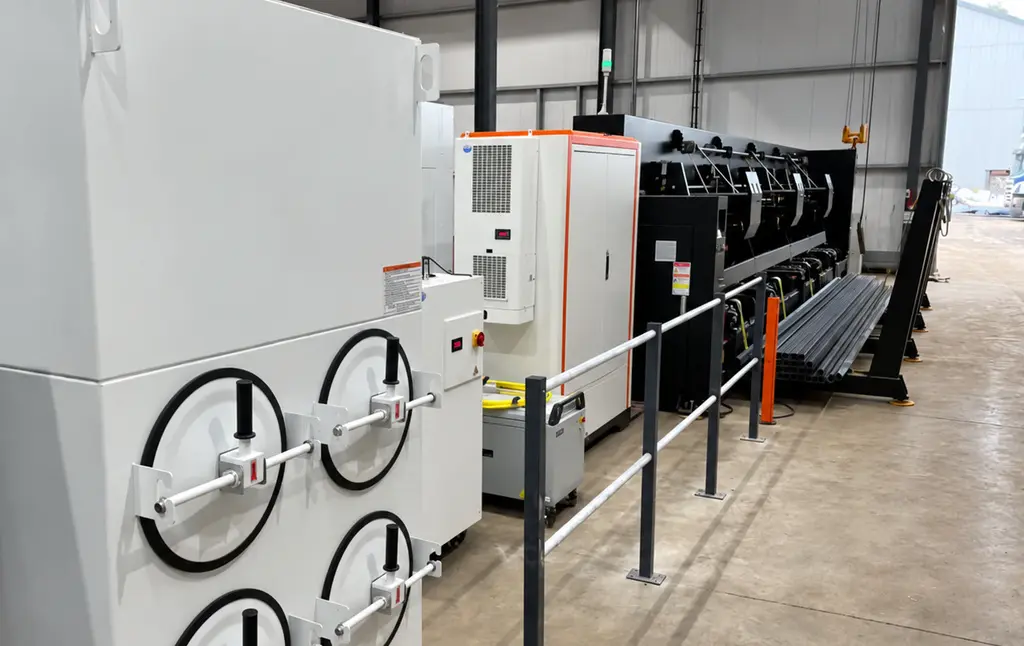
Tube laser automation controls how long stock is loaded, held, moved through the cutting process and discharged. It can reduce repeated handling from a prepared supply, but each stage must suit the profiles you actually use.
A maximum chuck diameter gives only part of the picture. The loader may have its own size and weight restrictions, while outfeed equipment must support the finished components. A useful specification follows the material from the incoming bundle to the next workshop operation.
Loading prepares stock for the machine
Manual loading normally relies on an operator placing stock into the specified loading arrangement. Semi-automatic systems take over part of the movement after an operator has prepared or positioned the material. Fully automatic systems may select and feed lengths from a prepared supply.
Those descriptions vary between machines. Ask the supplier to demonstrate precisely which tasks require an operator, how the system separates stock and how it responds to a loading problem.
For repeat tube work, automatic bundle loading can reduce the need to attend every raw length. Mixed profiles, short stock or irregular sections may need another method. The automation must be matched to the loader’s permitted material range.
Chucks position and rotate the workpiece
The chucks grip the stock and control its position as the programme cuts holes, slots and profiles. Their arrangement affects how the tube is supported and transferred through the machine.
Machine selection should account for profile shape and weight as well as outside diameter. Square and rectangular sections, open profiles and heavy stock behave differently during clamping and rotation. Confirm the approved profile envelope rather than convert every requirement into one diameter.
Different chuck arrangements can also influence the remaining unprocessed length. Claims about minimal remnants depend on the configuration and cutting programme, so ask for a trial with representative components.
Supports help manage long material
Long tube can sag or move between support points. Suitable supports help maintain its position as it advances and rotates, making them an important part of the cutting system.
Check how supports work with the shortest and longest stock you use. Review the effects of section weight, wall thickness and straightness. A long incoming length can require substantial handling capacity even when the individual components are small.
Material condition matters too. Stock outside the permitted straightness or dimensional tolerances can interrupt an automated sequence. Good loading equipment still needs suitable incoming material.
Unloading must suit the finished parts
The outfeed arrangement receives the component after separation. Short parts may be collected differently from long sections that need controlled support. Confirm finished-part length and weight limits independently of raw-stock capacity.
Ask where completed parts go and whether they remain identified by job. An automatic discharge system is not necessarily a system for sorting or palletising components. If staff need to collect and separate mixed parts frequently, that work remains part of the production cycle.
Protect appearance-critical or slender components during the demonstration. The way a part leaves the cutting area can affect its usability even when the cut itself is satisfactory.
Software coordinates the production sequence
Tube programmes define more than the cutting outline. They must account for stock lengths, component orientation, clamping and support movements. Nesting determines how parts are arranged along the available stock and where remnants remain.
A programme queue can support continued production, provided the correct material is available and the handling system can accommodate each job. Confirm how material changes and interrupted programmes are managed.
Measure accepted components per hour. A fast cutting demonstration does not show the time required to load a bundle, change profiles or clear finished parts.
Specify automation around your profile schedule
Prepare a list of material grades, section dimensions, wall thicknesses, stock lengths and finished-part lengths. Add batch sizes and representative nests so the supplier can check the complete cycle.
The Morgan Rushworth XTC Compact Tube Laser and XTR Tube Fibre Laser are examples to investigate within the wider range; confirm the exact handling configuration for your work.
Explore our tube and section laser machines or use our tube laser selection guide as a starting point. Selmach can help you assess loading, support and unloading together.
Published 6th October 2026