
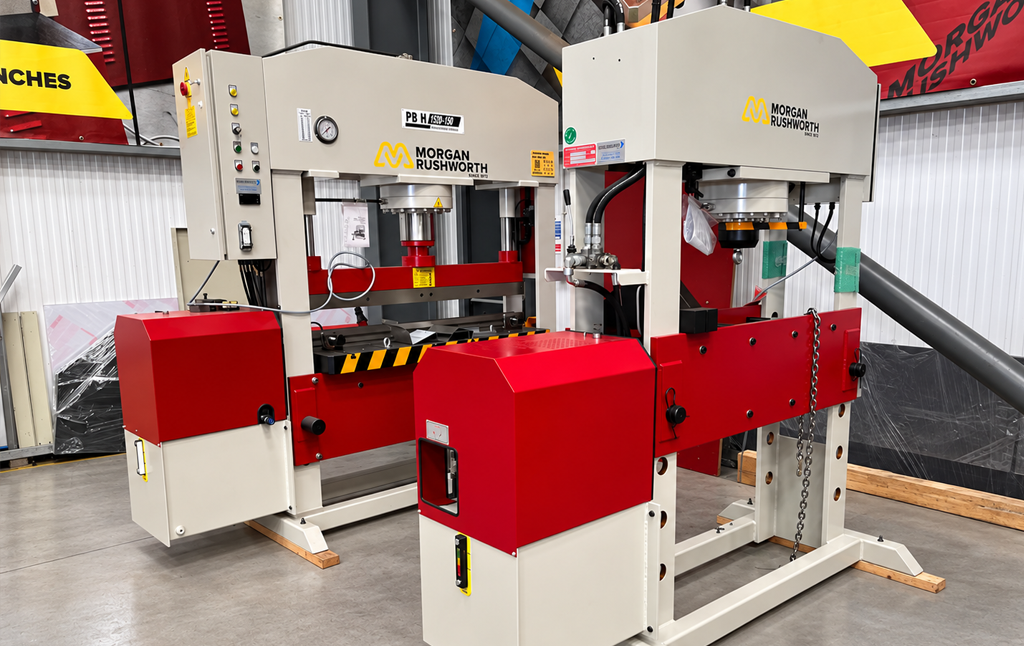
A hydraulic press can earn its place in a fabrication workshop through a wide range of jobs: pressing a component into an assembly, straightening a part, forming a simple shape or applying force through dedicated tooling. The correct H-frame machine depends on much more than its tonnage figure.
This guide helps you turn the jobs you actually perform into a practical specification. Selmach offers Morgan Rushworth manual and hydraulic H-frame presses, including models with different work areas, controls and tooling arrangements. Start with your parts and process, then compare the machines.
Define the operation and the force required
List the pressing tasks you expect to perform: bearing or bush installation, straightening, bending, forming, assembly or toolroom work. The force needed depends on the material, the contact area, the tooling and the operation. A press’s rated tonnage is a maximum machine rating under specified conditions, not a universal answer to every part. Do not estimate a safe working load from the machine name alone; obtain the tooling and process requirements for the job.
If several tasks use the same machine, specify the most demanding legitimate job while checking that the press remains practical for routine work. See our tonnage and working-area guide for the measurements to record.
Make sure the part fits inside the frame
Measure the largest component and the tooling stack together. Check the distance between the uprights, the table dimensions, the available daylight between ram and bed, and the ram stroke. An apparently adequate press can become unusable if a tall fixture consumes the opening or the ram cannot reach the job through the required travel.
Consider access and handling as well. Can the component be loaded without awkward lifting? Will it need support on both sides? Can it be positioned so the load is applied as the machine and tooling manufacturer intend? A suitable press is one that can accommodate the complete setup, not simply the bare component.
Manual or powered operation?
A manual H-frame press can suit occasional jobs where the operator benefits from direct, deliberate control and the workload does not justify powered operation. A powered hydraulic machine may suit more frequent or demanding production. Compare cycle time, control method, ram movement and operator access against your daily use.
The Morgan Rushworth DP manual H-frame press and the HFP hydraulic H-frame press illustrate two options within Selmach’s range. Our manual versus powered press comparison sets out the questions worth asking.
Consider ram and table arrangement
The location of the pressing point matters. If workpieces vary significantly in width or require operations away from the centre, consider the available ram movement and whether a moving-ram arrangement is appropriate. Check that the chosen machine, tooling and setup permit the load at the intended position. A moving ram is a flexibility feature, not a reason to ignore the machine’s loading limits.
The fixed versus moving ram guide explains this decision. Review the current HFP, HFPV and HFPX product pages for model-specific arrangements rather than assuming all H-frame presses operate alike.
Plan tooling before purchasing
V-blocks, pressing plates and dedicated fixtures can change what the press can do, but they must be suitable for the load and component. Think about where the force enters the part, where the reaction is supported and how the part will be kept stable. Straightening a section and pressing a bearing into a housing are different setups.
Our press tooling and workholding article covers questions to discuss with the team. Use the operating instructions, correctly rated tooling and your site’s procedures for actual press work.
Is an H-frame press the right format?
An H-frame press is a versatile choice for point-load and shorter forming tasks. If the job is repeated, precision bending across a long sheet, a dedicated press brake may be more suitable. If the operation needs force applied horizontally to a compact section, consider a horizontal bending press. Our H-frame versus horizontal press guide helps distinguish the layouts.
A useful enquiry includes the whole job
Share the part dimensions, material, operation, expected force or tooling specification, the number of cycles and available floor space. Photos or a drawing of the existing setup are useful. If you need bending as well as pressing, include the bend length and desired repeatability.
Explore the Morgan Rushworth H-frame range or contact Selmach to discuss the application. We can help compare the practical requirements and arrange a demonstration of a suitable machine.
Published 30th September 2026