
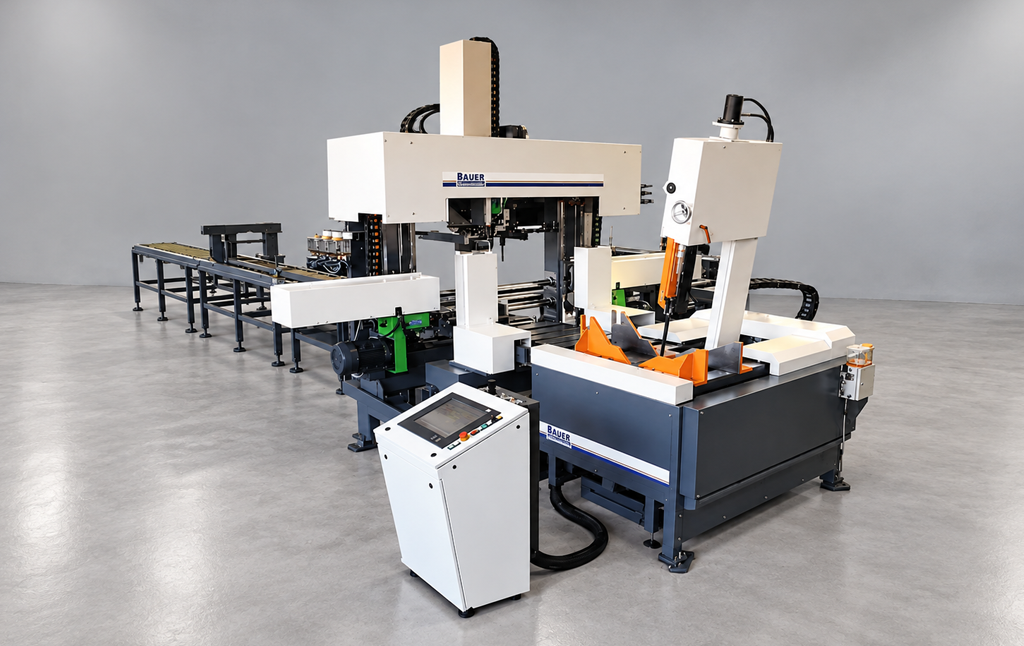
Structural steel preparation can involve a sequence of measuring, sawing, marking, moving and drilling. If your workshop repeats that sequence across many lengths and jobs, it is worth asking whether a CNC saw and drill line would reduce handling and make the output more consistent.
Identify the bottleneck
Record the size and type of sections you process, the typical length, the number of holes and cuts per member, and the daily volume. Observe where the material waits. Is the saw keeping up while drilling falls behind? Are operators moving a heavy part between stations several times? Or is programming and loading the real constraint?
A CNC saw and drill line combines programmed cutting and hole-making in a workflow designed for long material. Selmach’s range includes Bauer equipment for these applications. Check the machine’s actual section capacities, feed arrangement, hole requirements and available space against your stock, rather than assuming every beam or profile fits.
Compare it with the alternatives
An automatic bandsaw can be an effective solution if cutting length is the main repetitive task and drilling is infrequent. A tube and section laser may suit a different mix of profile cuts and features. The decision is about the finished member and production volume, not simply the degree of automation.
Look beyond cycle time. Material staging, output sorting, drawing quality and installation access can determine whether the line delivers the expected benefit. If current processes handle low volumes of highly varied work, a dedicated line may not be the first investment to make.
Our CNC machines for metal fabrication guide maps the wider choice. Send Selmach representative member drawings and weekly volumes so we can compare a saw and drill line with your present route.
Published 30th September 2026