
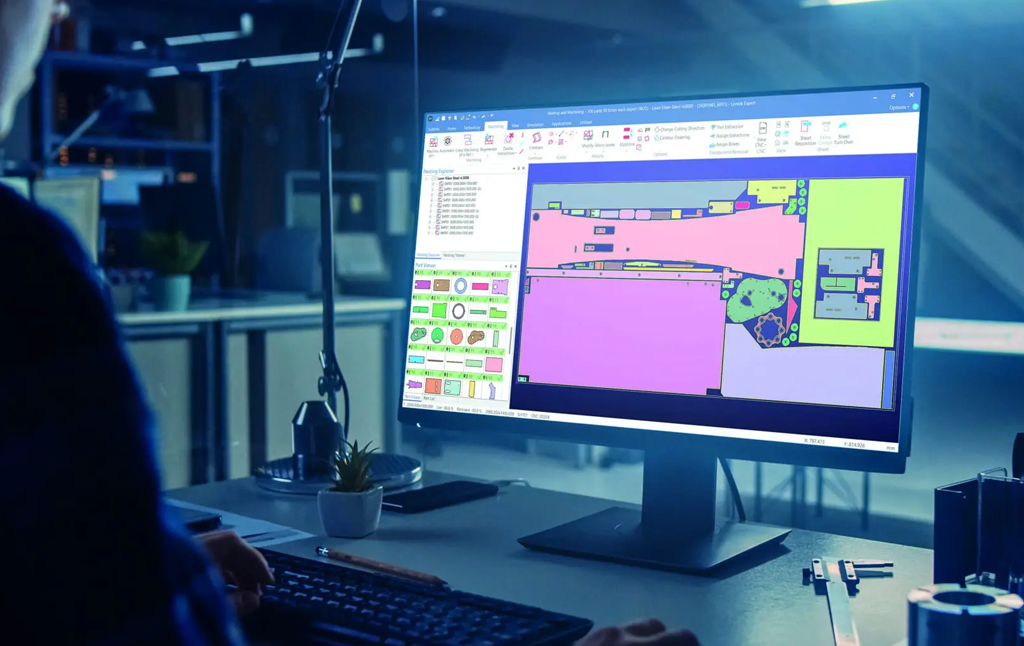

When a CNC turret punch is busy but output is disappointing, the headline stroke rate may have little to do with the problem. Time can be lost in sheet travel, tool selection, repositioning, changeovers and the handling of finished parts.
Programming efficiency starts with the complete nest and production route. The aim is to produce more acceptable parts from the available material and machine time, while preserving quality and safe operation.
For workshops reviewing a new CNC turret punch press or improving an existing process, a representative repeat job is a better starting point than the fastest marking figure in a specification table.
Measure the complete cycle before changing the programme
Separate programming and setup time from the repeated sheet cycle. Within that cycle, record loading, processing, unloading and the necessary inspection or part-separation work. Identify where the operator is waiting and where the machine is waiting.
Keep the conditions consistent when comparing programmes. A new nest may appear faster because inspection or unloading has been left out of one timing, rather than because the processing has improved.
Measure acceptable parts per hour as well as seconds per sheet. Record scrap and rework separately, because a faster run that creates more rejects may reduce useful output.
The tightest nest is not always the most productive
Material utilisation matters, but a sheet with the most components can require more movement, additional tools or another reposition. Part orientation may also change which tools and index angles are required.
For a simple illustration, suppose layout A produces 24 acceptable parts in a complete 12-minute sheet cycle. Its theoretical repeat-cycle output is 120 parts per hour. Layout B fits 26 parts but takes 15 minutes for the same defined cycle, giving 104 parts per hour.
Those are illustrative figures, not machine performance claims. Layout B may still be preferable if its material saving outweighs the extra time. The point is to compare both outcomes using the same costing assumptions and quality standard.
Do not rotate parts purely to improve sheet utilisation if the drawing or material specification fixes grain direction, surface orientation or another manufacturing requirement.
Nest around the tooling that will actually be installed
A mixed nest can look efficient on screen while requiring more tooling than the turret can carry in the necessary station sizes. Check the tool list, index requirements and available positions before treating it as a production-ready solution.
Consider grouping jobs with compatible materials and useful common tooling. Keeping a suitable tool set installed across several repeat jobs may reduce setup work, although due dates and batch priorities still need to be respected.
The CAM turret record must match the physical machine. Metalix provides turret-handling and nesting functions that can account for tooling restrictions in supported configurations. Confirm which functions are included in the installed software and configured for the press, rather than assuming that every feature shown in a software demonstration is available.
Balance tool grouping with sheet movement
Processing every occurrence of one tool together can reduce tool-selection events. However, it can also create long sheet movements or an unsuitable sequence for a delicate component.
Review the simulated route, not just the total number of hits. Compare unnecessary travel, repeated indexing and the way the sheet remains supported as openings are created. A shorter tool list does not automatically produce the shortest or most reliable programme.
Tool life and heat generated during repeated operations also deserve consideration. A grouping strategy that concentrates demanding hits into one uninterrupted sequence may need review with the tooling supplier. Programme changes should remain within the machine and tooling recommendations.
Treat repositioning as a planned operation
Repositioning allows a suitable press to process sheet beyond its direct working range by changing how the sheet is held and located. It adds an operation that must be supported by the machine, clamps, programme and material arrangement.
Review whether a different nest, sheet format or orientation can avoid an unnecessary reposition. Do not simply remove a reposition from a programme or move clamps outside an approved setup to gain access to more material.
The CAM system must account for clamp restrictions and the permitted working area. The approved sequence must retain control of the sheet and provide access to the features still to be processed. Check the supplier’s procedures and use the appropriate simulation and prove-out process before production.
Plan for forms and the remaining sheet skeleton
Raised forms change the clearance required as the sheet moves. Large cut-outs and closely spaced components can also leave a less rigid skeleton to carry through later operations.
Review the timing of forming and separation operations alongside the path. Any micro-joints or retaining features need to suit the component, material and handling method. Too little retention can create an unstable process; excessive retention can move time into manual separation and finishing.
The correct strategy is specific to the job. A programme that is effective for a flat perforated panel should not automatically be reused for a sheet carrying tall forms or large unsupported areas.
Keep improvements that survive a full production run
Use simulation to screen changes, then validate the approved programme through the machine’s safe prove-out and first-off procedures. Compare complete batches, not just the most favourable sheet from each run.
Record the programme revision, tool layout, material, cycle definition and quality results. If an improved programme depends on a particular setup, make that requirement visible in the production record.
When comparing the TPH hydraulic range and TPS servo-electric range, ask for the proposed nest, tooling and repositioning plan alongside the cycle estimate. This connects the machine specification to the work it will actually do.
To discuss capacity or a production bottleneck, explore Selmach’s CNC punch presses and bring a recurring drawing with its current timings. Knowing where the minutes go is the first step towards deciding whether the answer is a better programme, a different setup or a different machine.
Published 1st October 2026