
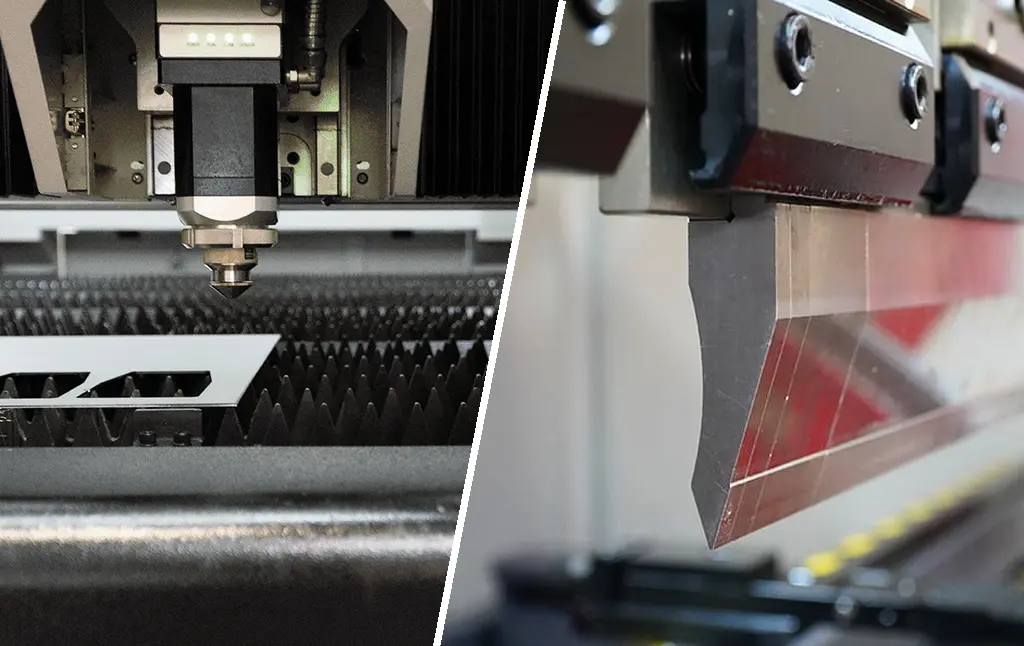
Increasing fibre laser output can reveal a problem elsewhere in the workshop: components reach bending faster than the press brake team can process them. The result is more work in progress, longer searches for parts and a growing queue between machines.
The solution starts with the whole route from cut sheet to finished component. Selmach’s automation guidance introduces the wider production question. For laser-to-bending work, the practical detail is how parts are prepared, identified and released to the press brake.
Map the route after cutting
Follow one representative job through the workshop. Record when cutting finishes, when parts are separated, when edge preparation is complete and when bending begins. Note both working time and waiting time.
A part may spend only a few minutes being processed but several hours waiting for a complete kit, a trolley or the correct tooling. Measuring the press brake alone will not show these delays.
Include inspection and rework in the route. If unsuitable components arrive at bending, the brake operator becomes the person who finds and resolves an upstream problem. That interrupts the schedule and obscures the actual constraint.
Make edge preparation a planned operation
Cut quality and the component specification determine whether deburring or other preparation is needed. Do not treat it as an informal task that someone fits in when convenient.
Decide which parts need preparation, what acceptance standard applies and who releases them for bending. Thin parts, small features and coated surfaces may need different handling arrangements. A consistent process helps avoid uncertainty at the press brake.
Selmach’s deburring and bevelling equipment can form part of this route. Equipment selection should reflect the actual parts and finish required, alongside the throughput of cutting and bending.
Deliver complete jobs with clear identification
A dense nest can contain components from several customer orders. That improves material use, but the bending team still needs complete, correctly identified jobs.
Use a defined collection location for each job and a consistent method of recording part numbers, quantities and revisions. Check that the flat pattern and bending information refer to the same approved drawing version.
Where components look similar, identification deserves particular attention. A slightly different hole position or flange length may not be obvious in a stack. Avoid relying on memory to distinguish parts that will be bent differently.
Plan the bend sequence before releasing the nest
Tool availability, bend sequence and component handling affect how quickly a job moves through the press brake. Review these requirements while preparing the cutting programme rather than after a trolley arrives at the machine.
Group compatible work where this reduces useful setup time, but keep delivery priorities visible. A large batch that saves a tool change may delay urgent components or create excessive stock between processes.
Check the suitability of the press brake for the longest, heaviest and most difficult parts in the intended workload. Nominal bending capacity does not describe every handling or access requirement.
Balance release with bending capacity
The laser does not always need to release its maximum possible output. A controlled release of complete kits can be more useful than repeatedly filling the floor with unfinished work.
Establish a practical limit for the queue awaiting bending. When the queue reaches that limit, review priorities or release work for another route. This makes a developing constraint visible before it becomes a workshop-wide delay.
Measure finished components leaving bending, not only sheets leaving the laser. If cutting output rises while completed orders remain unchanged, the extra output may simply be accumulating between processes.
Test the workflow with a real job
Choose a repeat order containing several part types and bend setups. Compare its total lead time, handling effort and missing-part incidents before and after changing the route.
That trial may identify a need for better job information, a dedicated preparation stage, different batch sizes or more bending capacity. It gives a stronger basis for investment than assuming the next machine must be faster.
Discuss your drawings, current queues and production priorities with Selmach. We can help you review the route between fibre laser cutting and bending so that equipment decisions support complete jobs moving through the workshop.
Published 13th October 2026