
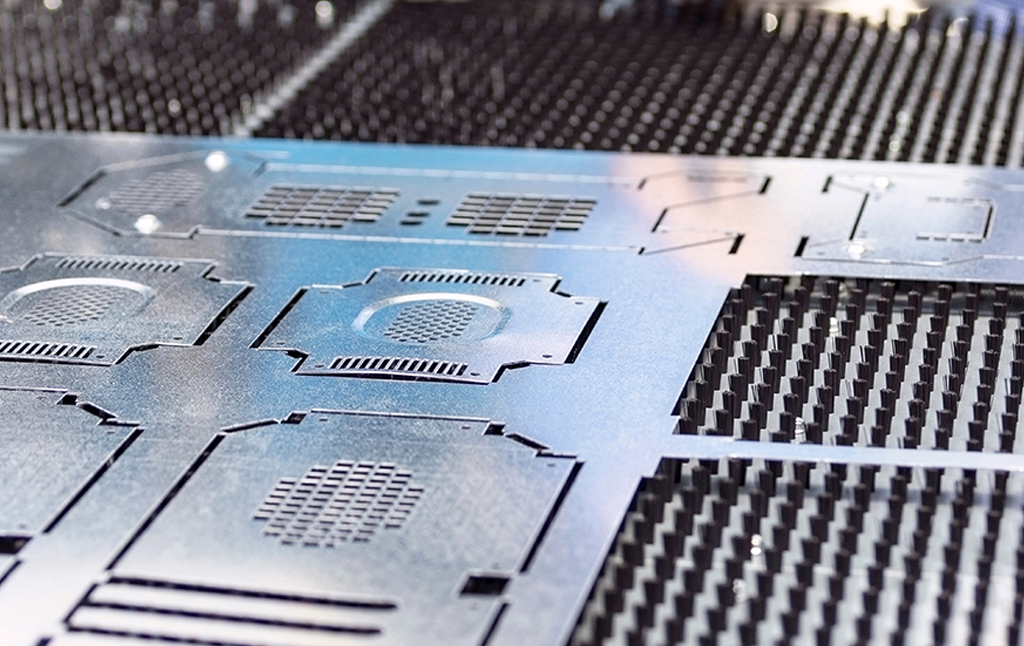
A CNC turret punch is often considered for holes, slots and sheet-metal profiles. Its wider value becomes clearer when a component also needs ventilation features, mounting details or local formed shapes.
With suitable tooling and a compatible machine configuration, a turret press can combine some cutting and forming operations in one programmed process. That may remove a separate handling or tooling stage. It does not mean every press can produce every form, or that all secondary operations disappear.
When assessing a CNC turret punch press, show the supplier the finished component as well as its flat pattern. Features that look minor on the drawing can have a significant effect on how the part should be manufactured.
Louvres for ventilation panels
A louvre combines an opening with a raised or displaced section of material. It is a useful example of a feature that requires more than simply cutting a hole.
Louvre tooling can create ventilation details in suitable sheet material. The required opening, form height, spacing and direction should be established from the component design, along with the acceptable appearance on each face.
An enclosure drawing might call for several rows of louvres near one edge. The tooling assessment needs to consider the entire arrangement, not just whether one louvre can be produced in isolation. Nearby bends, clamps and previously formed features can affect access and processing order.
The final ventilation design still needs to meet the product’s requirements. A punched form alone does not establish airflow performance, weather resistance or an enclosure rating.
Embosses and local reinforcing features
An emboss raises or recesses a defined area of the sheet. Depending on its design, it may provide a locating detail, spacing feature or local shape within the component. Other forming tools can create ribs intended to influence stiffness.
These features should be evaluated as part of the part design. A formed rib is not automatically a substitute for thicker material or a separate reinforcement. The required load, geometry and acceptable deformation need engineering confirmation.
Forming also moves material. The resulting dimensions and flatness should be checked on sample parts, particularly where an emboss sits near a hole pattern or a future bend.
Lance and form features for assembly
Lance-and-form tooling cuts part of a shape and displaces it while leaving it attached to the sheet. Suitable designs can create tabs, bridges or clips used for locating, retaining or routing components.
For example, an integral retaining detail may avoid a separately fitted bracket on a suitable assembly. Whether that change is worthwhile depends on the required retention, fatigue life, access and finish, not just the number of pieces removed from the bill of materials.
Tooling manufacturers also offer locating forms and extruded features for specific joining arrangements. These are possibilities to assess with the component designer and tooling supplier, rather than interchangeable features that can be added to any drawing without validation.
Extruded holes and threaded features
An extruded hole forms a collar around an opening. In a suitable application, the extra material height can support a subsequent fastening operation.
An extrusion is not automatically a finished tapped hole. Thread requirements may call for a separate tapping operation, a compatible dedicated tapping system or a different joining method. The material, wall thickness, hole preparation and required thread engagement must be assessed together.
Do not assume that mentioning tapping in a general punch-press brochure means an integrated tapping system is included in a particular quotation. Ask how the complete feature will be produced and inspected on the proposed machine.
Repeated holes and cluster tooling
A cluster tool contains several cutting elements and can produce multiple holes in one hit. For a suitable repeated pattern, this offers a different route from punching each hole individually.
The trade-off is that the combined cutting requirement, tooling layout and stripping demand must suit the machine and material. Pattern changes may require different tooling, while dense perforation can make sheet flatness and processing sequence particularly important.
Compare a cluster solution with a standard-tool programme using the actual batch sizes. A dedicated tool may be attractive for a stable repeat product, but less useful where hole spacing changes frequently.
Check what happens after the first feature is formed
A flat sheet is relatively straightforward to support and move. Once raised forms have been added, the programme must account for their height and position throughout the remaining operations.
Check clearance to the turret, tooling, clamps and table arrangement. Consider whether another operation could flatten, mark or collide with an existing form. The safe sequence is application-dependent and must be validated using the machine’s programming and operating procedures.
The formed sheet also needs a practical unloading and stacking method. Parts that nest neatly when flat may no longer stack the same way after forming, so handling time belongs in the production comparison.
Compare the whole manufacturing route
Consider an illustrative enclosure panel with mounting holes, a cable opening, louvres and a small locating feature. A turret solution might combine several of those operations before the panel moves to a press brake for its main bends.
The alternative could involve profile cutting followed by separate forming operations. Neither route wins automatically. Compare tooling cost, batch frequency, processing time, handling, quality checks and the flexibility needed for later design changes.
The Morgan Rushworth TPH and TPS ranges provide platforms for assessing punching and suitable forming applications. The final capability depends on the selected model, tooling, options and material.
If your parts need more than flat cut-outs, send Selmach the finished-part drawing and a sample where available. Explore the CNC turret punch range with the complete manufacturing route in mind: the strongest case may be an operation you no longer need to carry out elsewhere.
Published 1st October 2026