
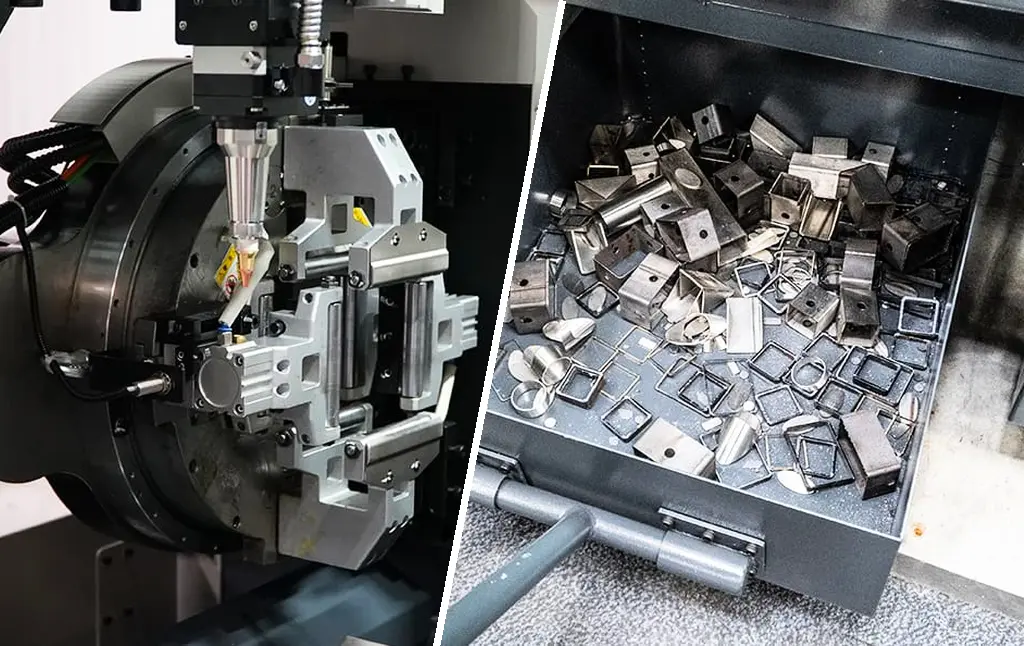
The length of stock purchased is not the same as the length available for finished components. A tube laser needs to hold and process material, and the usable length depends on its configuration and the job.
Understanding these allowances helps fabricators compare equipment, prepare accurate quotations and decide whether a remnant is worth retaining. Material yield should be assessed across the whole order, not only through the appearance of a nest on screen.
Understand what creates a remnant
A remnant is the length left after planned components have been cut. Part may be associated with the machine’s gripping and processing requirements; another part may simply be too short for the next component in the nest.
Separate these causes when assessing yield. A machine-specific end allowance and an avoidable nesting leftover are different problems with different solutions.
Ask the supplier to explain the usable-length calculation for the exact configuration. Do not apply a published minimum remnant figure to every profile, job or operating arrangement without checking its conditions.
Include all allowances in the programme
The calculation needs the relevant stock-end treatment, gripping restrictions and cutting allowances as well as nominal part lengths. Their treatment depends on the machine and programming method.
As a purely illustrative calculation, suppose a 6,000 mm bar has a total non-part allowance of 340 mm for a particular job. That leaves 5,660 mm. Seven 800 mm components require 5,600 mm, leaving 60 mm within the assumed usable allowance. Eight would not fit.
This example is arithmetic, not a specification for a Selmach machine. Real allowances must come from the validated programme and equipment requirements.
Mix part lengths where orders allow
Combining suitable components from different orders can improve utilisation. Shorter parts may fit into space that would otherwise remain unused after longer components.
Parts must be compatible in material, profile and other stock requirements. Delivery priorities also matter. An efficient nest is less useful if it delays an urgent order while waiting for another job.
Keep identities and quantities clear through cutting and collection. Material savings should not create incomplete kits or sorting work that outweighs the benefit.
Confirm common cut capability
Some programming and cutting arrangements can share cuts between suitable components. Whether this is appropriate depends on geometry, end requirements, process settings and supported capabilities.
Confirm how software calculates the resulting allowance and how required ends are produced. A cut serving two parts must meet both specifications.
Avoid assuming every profile or end shape can use the same approach. Validate the part family before including a saving in quotations or production targets.
Keep remnants that can be reused
A leftover has practical value when it can be identified, stored and processed again within the machine’s supported limits. That requires more than putting it in a rack.
Record the profile, material specification, length and traceability information required by the job. Decide how the programmer will find it and how its suitability will be checked.
Include the work needed to load and process it. A small remnant requiring disproportionate identification and handling effort may not provide a worthwhile saving.
Measure yield using accepted output
Track material purchased or issued against accepted finished components over representative orders. Include rejected parts and stock that becomes unusable.
Use a consistent basis, such as mass, and define the boundary of the measurement. Length alone can mislead when comparing different profiles or wall thicknesses.
Keep reusable remnants separate from scrap, then record whether they are actually consumed later. Counting every retained leftover as a saving can overstate results if the rack fills with unused material.
Compare machines with your part list
Ask for a nesting and processing assessment using real stock and typical orders. Include long components, short components, mixed lengths and the profiles accounting for most of your material spend.
Compare usable output and handling together. A configuration reducing end waste may have other implications for loading, unloading or the range of work supported.
Selmach can help review the tube and section laser range against that workload. Bring part lists, stock lengths and details of current remnants so the discussion focuses on practical material use.
Published 13th October 2026