
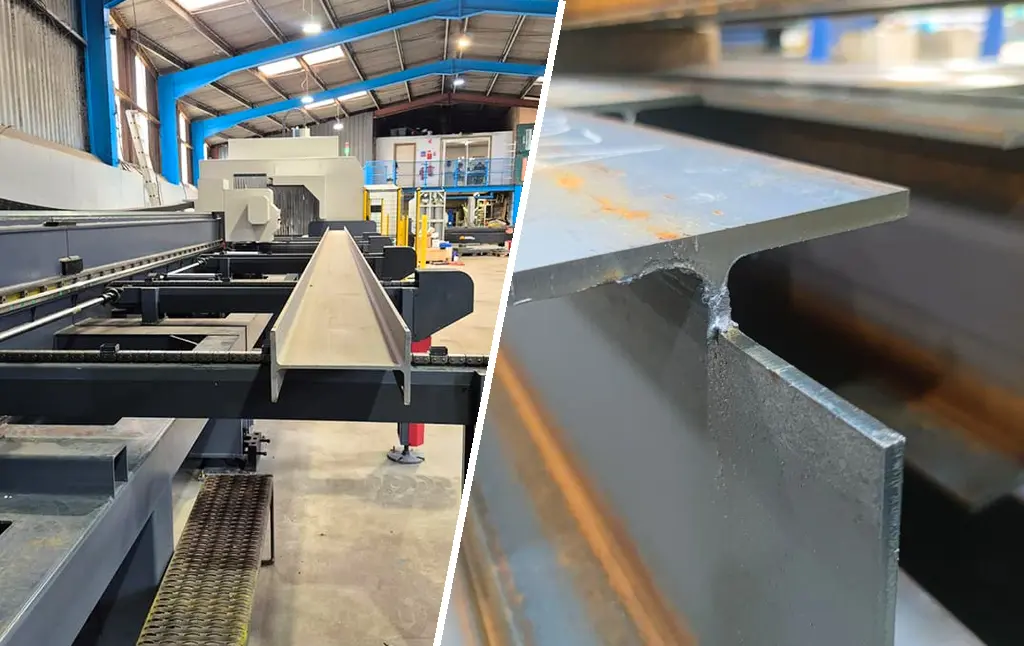
The phrase tube laser does not describe every profile a machine can process. Some configurations support selected open or structural sections as well as round and rectangular tube, while others are intended for a narrower workload.
For channels, angles and beam-type sections, ask whether the complete configuration can load, support, grip, programme, cut and unload your particular work. A profile fitting within one published envelope is only part of the assessment.
Why open sections need consideration
Closed tube provides a continuous section around its perimeter. Open profiles have exposed edges and shapes that can behave differently when gripped, rotated or supported.
A channel or angle may have an uneven distribution of material around its centre. Larger structural sections introduce additional questions about weight, stiffness and handling.
The supplier needs the actual profile specification, length and drawings. A generic description such as channel section is not enough to confirm suitability.
Check gripping and support
Ask how the section is located and held throughout the operating sequence. Confirm the shapes supported by the chuck or gripping arrangement and what additional equipment is required.
Review support along the stock and at the cutting point. Straightness and the condition of the supplied section should be assessed against the equipment’s stated requirements.
For long or heavy sections, confirm loading and discharge as well. The machine must handle the entire component through the cycle, not simply hold a sample in the cutting area.
Confirm access to features
The cutting head needs access to the surfaces and features shown on the drawing. Webs, flanges and return features can restrict access or create geometry-specific processing requirements.
Ask for a demonstration on representative sections. Check whether features can be produced from the necessary directions and whether repositioning or another operation remains necessary.
If bevelled or angled features are required, confirm capability for the actual head and configuration. Do not infer it from a general description or another machine in the range.
Review programming support
Software must represent the profile and required features correctly. Confirm support for the section type, orientation and relevant material or geometry compensation.
Discuss how stock variation is handled within the machine’s capability. Nominal CAD geometry and delivered structural material may differ, so the process needs an agreed way to maintain the required result.
Use current drawing revisions and a representative part family during the review. Selmach’s tube laser selection guide provides a starting point for defining the workload.
Judge cuts against the next process
A cut feature must suit its purpose, whether assembly, welding, bolting or another operation. Agree required dimensions, edge condition and inspection methods before the trial.
Laser processing does not automatically establish that every hole or edge is ready for its final application. The specification and fabrication requirements determine whether further processing is needed.
For structural work, involve the people responsible for those requirements. This establishes an acceptance standard without relying on a general claim that the machine can cut the section.
Include unloading in the demonstration
A machine may process geometry successfully while the finished component creates a handling challenge. Long sections, asymmetric parts and short offcuts need suitable discharge and collection.
Check support, collection capacity and the route to the next process. Include the longest and heaviest regular components, alongside small parts cut from the same stock type.
This matters when planning automation. Both the cutting cycle and automated handling cycle should be confirmed for the proposed work.
Build the specification around samples
Prepare samples covering the section types, lengths, wall or flange dimensions and features that matter most. Include ordinary repeat jobs and demanding examples.
Ask for a record of which work is supported, which needs extra equipment and which falls outside the configuration. This provides a practical basis for deciding whether laser processing complements or replaces your existing route.
Selmach’s tube and section laser range and structural steel fabrication guidance provide starting points. Bring actual profiles and drawings so the assessment covers the complete process.
Published 13th October 2026