
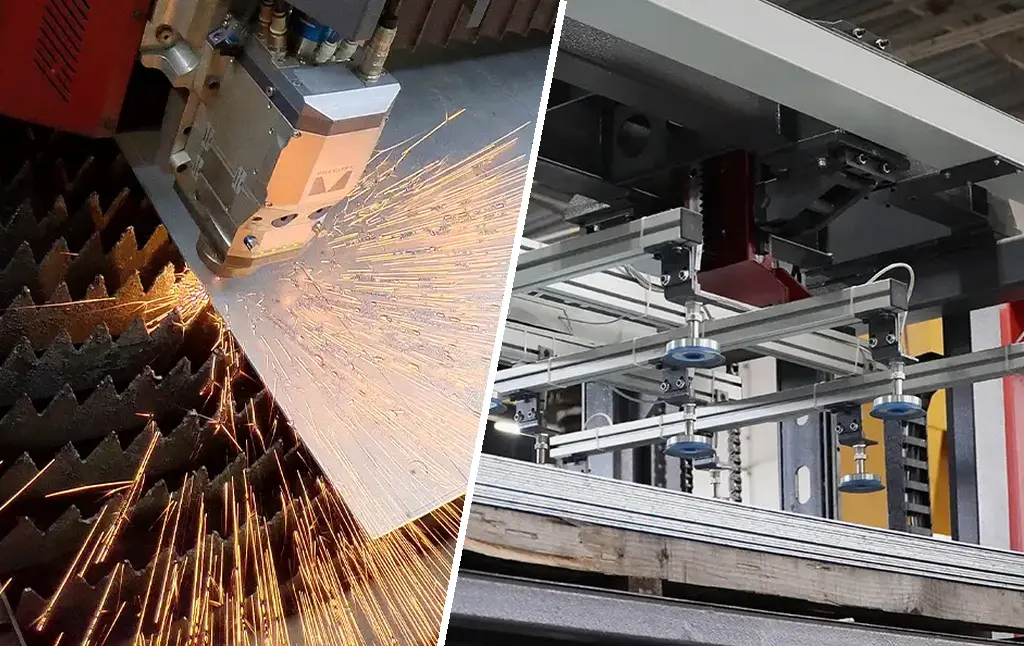
A higher-power fibre laser can shorten cutting time on suitable work. Automation can reduce the time lost moving material through the machine. Which investment improves output most depends on where your existing production cycle is constrained.
Before choosing, measure a complete job. Include loading, piercing, cutting, unloading and the handling needed to make components available for the next operation. That shows whether faster cutting will translate into more finished work or leave the machine waiting for the same manual tasks.
Separate cutting time from handling time
Record several representative nests rather than one favourable demonstration. Thin parts with many features may behave differently from larger profiles in thicker plate. Material changes and small urgent orders can also alter the balance.
Identify which activities overlap. On a shuttle-table machine, loading can take place while the other pallet is being cut. Adding those times together would overstate the complete cycle. Where stages cannot overlap, their individual durations have a more direct effect on output.
Also record machine waiting. Time spent with no prepared programme or no available material will not necessarily fall when the laser source becomes more powerful.
An illustrative comparison
Consider a simplified process where handling takes six minutes per sheet and cutting takes twelve minutes, with no overlap. The complete cycle is eighteen minutes.
If a higher-power machine reduced cutting time to eight minutes on that same nest, the cycle would become fourteen minutes. If automation instead reduced the effective handling stage to two minutes, the cycle would also become fourteen minutes.
Combining both changes could produce a ten-minute cycle in this simplified example. The figures are illustrative, not a prediction of any particular laser or loader performance. Actual systems have different piercing, motion and exchange arrangements, and the measured complete cycle is the figure that matters.
The comparison demonstrates why the most suitable investment cannot be selected from kW alone.
When more power deserves attention
Higher power may be useful when cutting is the dominant stage and your normal materials can be processed faster at the required quality. It can also broaden the machine’s useful production capability on thicker material within the complete specification.
Ask for trials using your drawings, grades and thicknesses. Compare accepted edge quality, piercing performance, holes and any secondary finishing. Faster travel along a straight edge may have a smaller effect on a nest containing many pierces and short contours.
Check the supporting services. Gas demand, extraction and electrical requirements form part of the decision, as do the cutting head and the rest of the machine. Increasing source power is not equivalent to upgrading the entire process.
When automation deserves attention
Automation is worth investigating where an otherwise capable laser repeatedly waits for an operator, stock movement or clearance of the previous nest. It may also help a workshop use the existing team across several tasks more effectively.
A compact loading and unloading tower or full tower system should be assessed against the actual material schedule. Check the handling cycle and what work remains manual.
If cut nests still need to be separated and sorted, include that labour. Removing a loading delay is useful, but it does not guarantee that finished components reach bending or welding any sooner.
Look beyond the laser before increasing output
More cutting capacity can overload downstream processes. Review deburring, part identification, bending and welding alongside the laser’s performance. Establish whether those operations can absorb additional work during the same shift.
The next useful investment might be improved scheduling or material preparation rather than either a larger source or a tower. Conversely, a busy workshop with both cutting and handling improvements to make has a meaningful choice.
Avoid using maximum source power as the business-case measure. Cost per accepted part and complete jobs delivered on time provide a more useful comparison.
Compare alternatives using one workload
Give each proposed configuration the same drawings and production assumptions. Record full cycle times, operator involvement, consumables and services, then assess the investment against realistic demand.
Explore our Morgan Rushworth fibre laser machines and discuss your current production figures with Selmach. We can help you compare machine power and handling options around the stages that currently limit your workshop.
Published 6th October 2026