
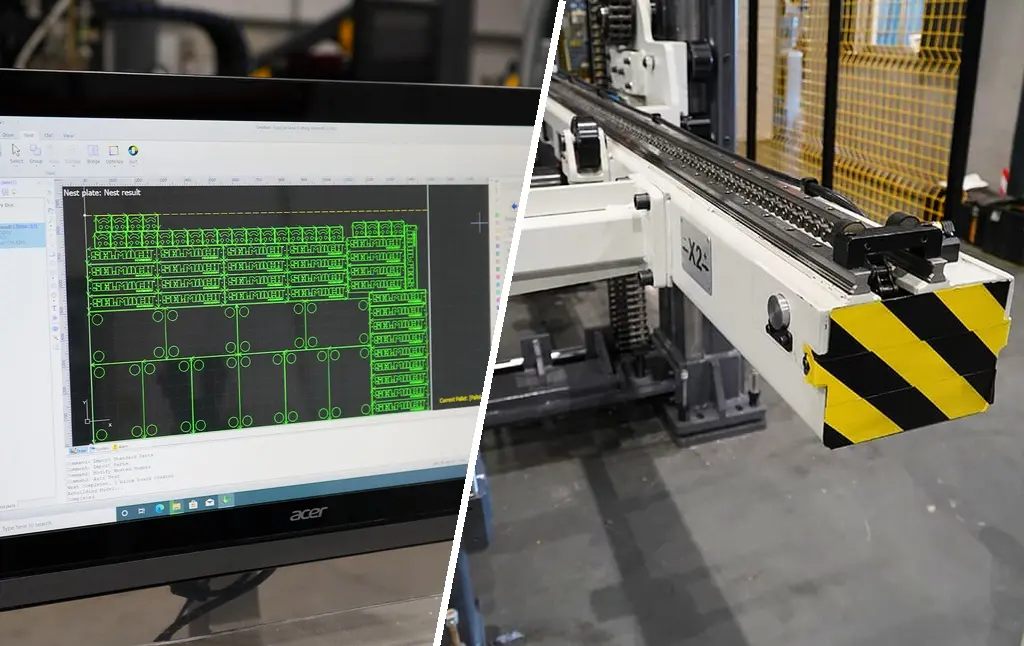
A good fibre laser nest uses material efficiently. An automation-ready nest also allows parts and skeletons to move through the intended handling process reliably.
These goals often work together, but they are not identical. A small gain in material utilisation can be outweighed by repeated sorting delays or difficult part collection. When planning fibre laser automation, the nest should be judged by its complete production result.
Start with the handling arrangement
Before nesting, establish what happens when cutting finishes. Will the complete nest be unloaded onto a pallet? Will individual components be retrieved? Will an operator separate parts before they reach the next operation?
Each route creates different requirements. Whole-nest unloading needs a manageable sheet and skeleton. Individual collection needs parts that the selected handling technology can locate and retrieve. Manual breakout needs an accessible, organised process.
Confirm these requirements with the machine and automation supplier. General nesting advice cannot substitute for the limits and approved programming methods of the actual equipment.
Check part stability
Small, narrow or unevenly supported components can behave differently from large panels. Heat input, cut sequence and the support arrangement can affect how a component sits in the sheet.
The programmer should consider whether parts remain suitable for the next handling stage. A successful cut does not automatically mean a successful pickup or a clean separation from the skeleton.
Retention features, including microjoints where appropriate, need a defined purpose. Their size, position and use must suit the material, machine and downstream separation method. Adding them by habit can create unnecessary breakout work; removing them without checking can cause handling problems.
Leave room for the collection method
The best orientation for material yield may not be the best orientation for retrieval. Collection equipment may require accessible surfaces, suitable support or enough space for its particular handling sequence.
This does not mean leaving arbitrary gaps around every part. It means using the correct technology-specific rules in the programming process. Ask how the software checks retrieval feasibility and which exceptions require a programmer’s attention.
Use nests containing perforated panels, narrow strips and your smallest regular components during the acceptance trial. An easy demonstration nest gives little information about difficult production work.
Keep mixed jobs understandable
Combining orders on one sheet can reduce material waste. It can also create incomplete kits or several nearly identical components that are difficult to distinguish.
Decide how each part will be identified and where it will be collected. Where automatic sorting is available, agree destination rules before running the job. Where sorting is manual, provide clear nest information and suitable containers.
Control revisions carefully. If one order changes after the nest is prepared, the team needs to know which programme and drawings remain valid. Selmach’s CAD and CAM training checklist is a useful starting point for reviewing this information flow.
Consider the skeleton and the next sheet
Automation needs a predictable route for both useful parts and scrap. Review the shape and handling of the remaining skeleton, the capacity of its destination and access for removal.
Also check how sheet condition affects the process. Material identification, flatness and surface condition should be considered within the equipment’s specified operating requirements. A nest cannot compensate for unsuitable stock or an incorrectly prepared handling system.
For longer planned runs, collection capacity matters as much as programme length. Include the points at which pallets, stacks or containers need attention.
Measure the complete result
Compare nests using material used per accepted job, cutting time, separation time, sorting effort and interruptions. Record whether downstream operations receive complete batches when they need them.
A slightly less dense nest may be worthwhile if it substantially reduces repeated manual handling. That is a decision to test against actual results, rather than a rule to apply to every order.
Keep a record of successful nesting rules for recurring part families. Review the rules when material, thickness, geometry or handling equipment changes.
Prove the nest through the full cycle
Run representative production from loading through to delivery of parts to the next process. Include a normal mixed order and an awkward part family, then record exceptions and required operator work.
Selmach can help you assess CNC fibre laser equipment alongside the intended material flow. Bring sample nests and drawings so that programming and handling requirements can be discussed together.
Published 13th October 2026