
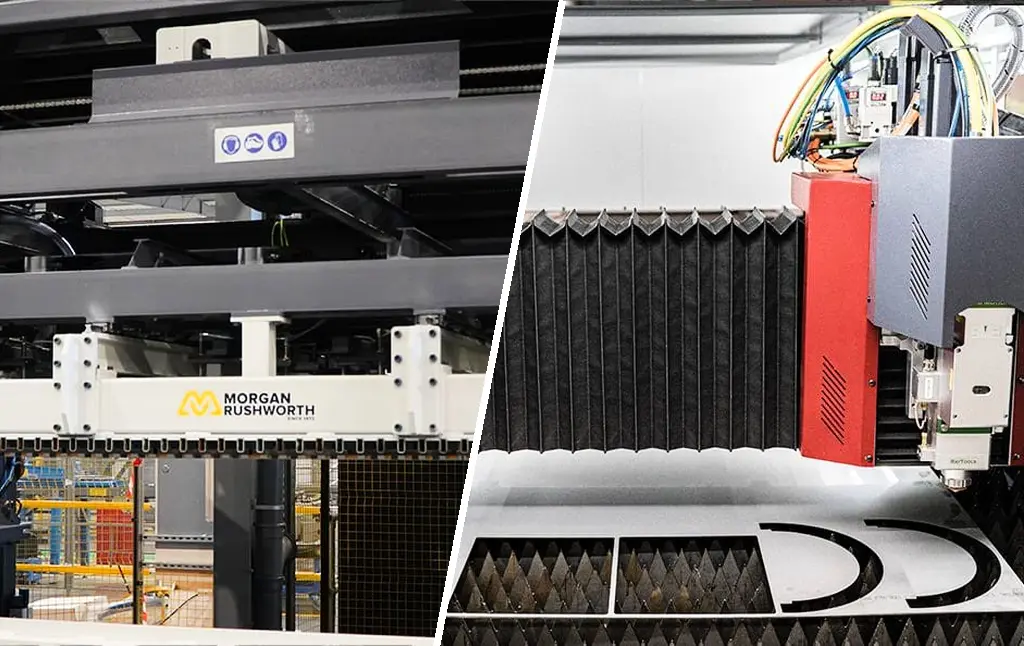
A fibre laser can finish a sheet quickly while the next job waits for someone to separate, identify and move the parts. Automatic part sorting addresses that work after cutting. Its value depends on the parts you make, how they leave the skeleton and where they need to go next.
For fabricators considering fibre laser automation, it helps to separate three functions: moving a sheet, removing the cut nest and collecting individual finished parts. They are different stages, and one system does not necessarily perform all three.
What automatic part sorting does
A sorting system retrieves individual components and places them in designated stacks, containers or collection areas. Depending on its design, it may work from programmed part information, sensors or a combination of both. Some arrangements separate parts from the skeleton before collection; others retrieve them directly from the cutting area or unloaded nest.
Sheet unloading alone can leave the full cut nest on a pallet. The operator still has to break out, identify and sort its contents. That may be entirely suitable for a workshop. The important point is to understand which tasks the proposed equipment actually removes.
Parts suitable for automated collection
Start with representative production nests rather than a sheet of identical demonstration parts. Include the smallest components, long narrow strips, heavily perforated parts and large flexible panels you regularly make.
The handling method determines what can be collected reliably. A vacuum-based arrangement needs suitable contact areas. Other technologies have different requirements for geometry, access and separation. Material condition, part weight, distortion and how the part sits after cutting can also affect the result.
Ask the supplier to demonstrate retrieval and placement, not simply a successful cut. Check how the system handles difficult parts and what happens when a part cannot be collected. Any recovery method should follow the equipment manufacturer’s approved procedure.
Nesting and sorting need to agree
A nest designed only to maximise sheet utilisation may be difficult to handle automatically. Closely spaced components, awkward orientations or unstable parts can create extra separation work.
The programmer needs to understand both cutting and handling requirements. Where joints or other retention features are used, their suitability depends on the machine, material and separation process. A feature that helps one unloading arrangement may create manual work for another.
This makes sorting a programming decision as well as a hardware purchase. Confirm that the proposed software generates the information the handling system needs and that the operator can see where every part should be placed.
Decide how parts should be delivered
Sorting is most useful when its output matches the next operation. A press brake may need components grouped by job and bend sequence. A welding cell may need complete assembly kits. A finishing operation may need batches separated by material or surface requirements.
Agree how parts will be labelled and how drawing revisions will be controlled. If several similar components share a container, the operator needs a reliable way to distinguish them. Otherwise, automated collection can still leave a manual identification bottleneck.
Also consider stack heights, container capacity and access for removal. A sorter cannot keep production moving indefinitely if its collection areas fill up before the next shift arrives.
Assess the benefit using real work
Measure the current time spent separating, sorting, counting and moving parts. Record delays caused by missing components, mixed jobs and damaged surfaces. Then compare the proposed system using the same representative workload.
Include the time needed to prepare collection locations, change containers and handle exceptions. The useful comparison is accepted parts delivered to the next process, rather than the number of robot movements or the speed of a demonstration cycle.
For some workshops, organised manual sorting alongside automatic sheet handling is the right balance. For others, individual part collection removes a persistent constraint. Neither conclusion can be reached from laser power alone.
Plan around your workload
Selmach’s CNC fibre laser range and automation options provide a starting point for reviewing cutting and material flow. Bring sample drawings, typical nests and details of the next operation to the discussion. Confirm individual part-sorting availability and compatibility for the proposed equipment separately from sheet loading, unloading or tower storage.
Published 13th October 2026