
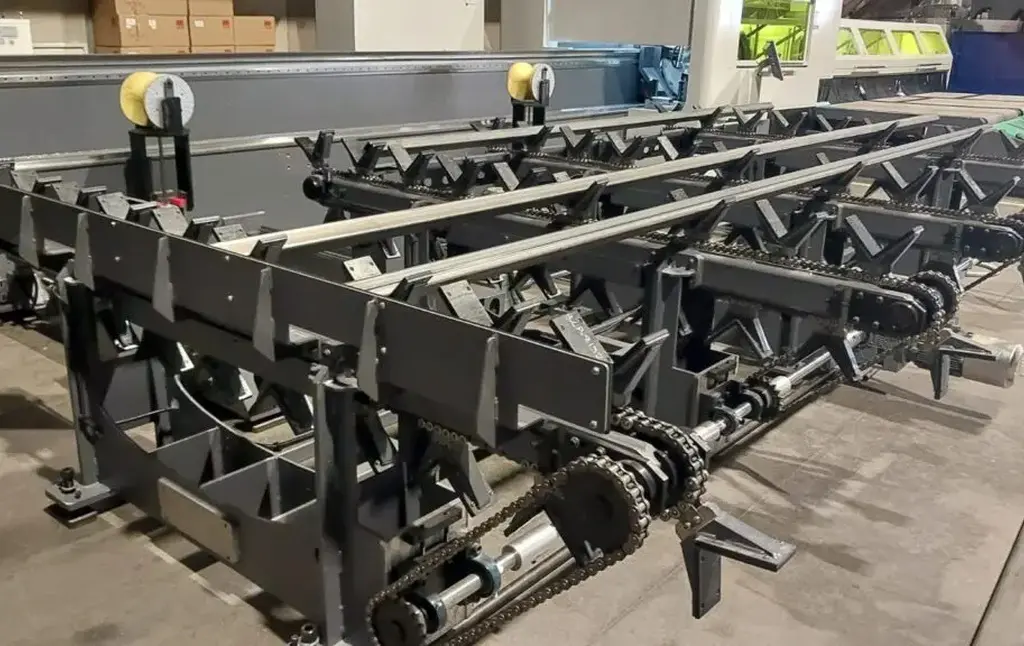
Automatic bundle loading allows a tube laser to take successive lengths from a prepared stock supply. For repeat work, this can reduce the need for an operator to present every tube individually and help maintain a more consistent production flow.
However, the loader must do more than move material towards the machine. It needs to separate stock, present it correctly and transfer it into the feeding arrangement. Its suitability depends on the profiles you actually use, their condition and the way your batches are organised.
Start with a prepared supply of stock
The operator introduces material into the loading area using the handling method specified for the installation. Bundle preparation, packaging removal and replenishment remain part of the production process. These tasks must follow the manufacturer’s instructions and the workshop’s agreed handling arrangements.
Check the permitted bundle weight, loading capacity and access requirements. The space needed to bring stock to the loader can be as important as the machine’s footprint, particularly where long lengths arrive by forklift or overhead crane.
A large stock capacity is useful only if it supports the work you intend to run. Preparing many identical lengths offers a different benefit from a schedule requiring frequent changes between small batches.
Separate one length at a time
The loading system separates an individual length from the supply and moves it towards the machine. The mechanism varies between designs, so ask to see this stage with representative material rather than relying on a description of automatic loading.
Stock behaviour matters. Round tubes can roll, rectangular sections have an orientation, and open profiles can nest together. Bent, damaged or inconsistent material may introduce handling problems even when its nominal dimensions are within the stated range.
Ask how the quoted system detects or responds to a failed separation. Recovery time and operator involvement affect the practical benefit of the loader, especially during longer batches.
Present and feed the tube correctly
Once separated, the tube must enter the intended feeding and gripping arrangement. Correct presentation helps the machine establish the position needed for the cutting programme.
For rectangular stock, confirm how orientation is established. Where weld-seam position matters to a component, ask whether the proposed configuration supports the required detection or positioning process. This is a feature to verify, rather than a standard capability to assume.
The loader, chucks and supporting equipment each have their own limits. A section that fits the machine’s chuck envelope may still fall outside the automatic loader’s approved range.
Support stock throughout processing
Long material needs suitable support as it moves and rotates. Review the complete arrangement with the supplier, including loading, transfer, cutting and discharge.
Provide outside dimensions, wall thickness, length and weight per metre for your regular profiles. Include lighter sections that may flex and heavier material that changes the handling requirement. Ask how supports are adjusted when the profile changes.
Automatic loading does not resolve every issue caused by poor incoming stock. Agree acceptable straightness and condition, and include typical workshop material in the demonstration.
Plan changes between batches
An automatic bundle loader should not be assumed to select arbitrary profiles from a mixed supply. Confirm which material changes require preparation, adjustment or operator attendance on the configuration you are considering.
Compare changeover time against the length of each batch. A loader may deliver substantial value on repeated orders while offering a smaller benefit on frequent one-off jobs. The aim is to automate a useful share of your workload.
Also check the minimum stock length accepted by the loader. A machine’s ability to cut short finished components does not establish whether short raw remnants can be loaded automatically.
Check what happens after cutting
Loading is only one end of the process. Finished components must be supported, discharged, identified and collected without restricting the next cycle.
Ask whether the receiving arrangement suits the longest and shortest parts in your schedule. If an operator must constantly clear the output, the staffing benefit will differ from a process that can accumulate a complete batch.
Our guide to how a tube laser can speed up production explains the wider opportunity to combine operations. For machine selection, start with what tube or section laser you need.
Demonstrate your complete material route
Ask Selmach to review your stock list, bundle sizes and normal production batches against the tube and section fibre laser range. A demonstration covering separation, feeding, changeover and finished-part collection will give you a clearer basis for choosing automation than cutting speed alone.
Published 6th October 2026