
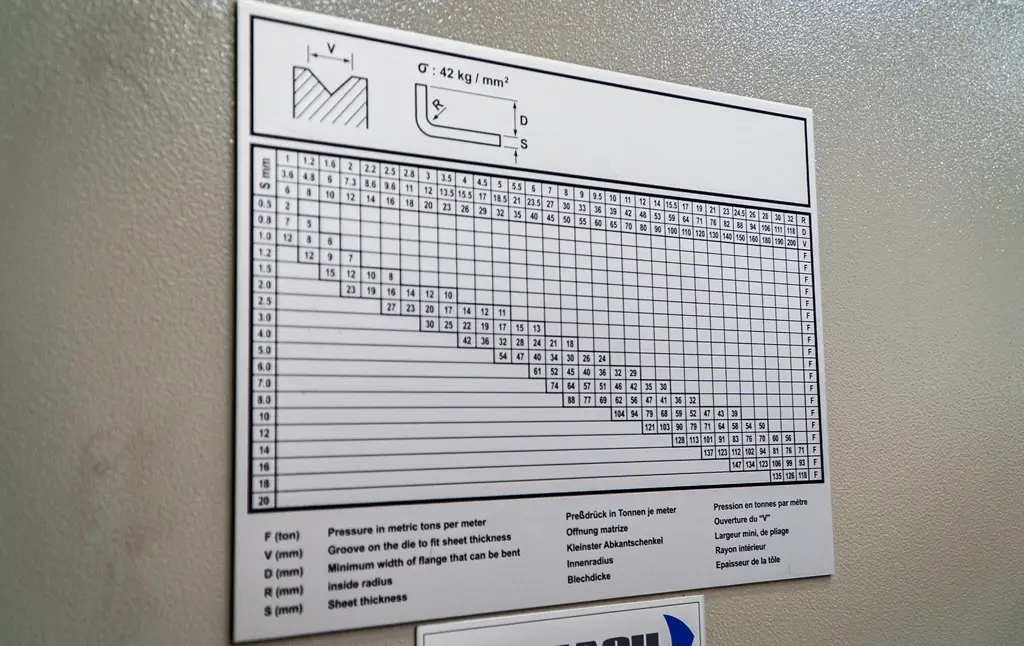
Material thickness and bend length are the starting point for press brake selection, but they do not establish capacity on their own. Material strength, forming method and tooling determine the force required and the shape that can be produced.
Identify the forming method
Air bending, bottoming and coining impose different requirements. A force estimate for an air bend cannot be used as a guarantee for another method. Specify the required angle, inside radius and minimum flange before deciding the tooling.
For an initial air-bending comparison, required force broadly increases with bend length, material tensile strength and the square of thickness, and decreases as V opening increases. Use a supplier-approved calculation or tooling chart with explicit units and material assumptions for the actual selection.
Why the V opening matters
A wider opening can reduce force but changes the achievable radius and minimum supported flange. A narrow opening can increase force and surface pressure. The punch, die and material must work together to produce the specified component.
Do not enlarge the V simply to make a machine’s headline tonnage appear sufficient. If the drawing requires a short flange or a particular radius, that tooling change may make the part unacceptable.
A 10 mm, three-metre enquiry
For 10 mm mild steel over 3,000 mm, provide the steel grade or strength, actual bend length, desired radius, minimum flange and proposed forming method. A 100 mm V opening may be a candidate to investigate, but it is not a universal selection. Confirm the resulting radius, support and force before naming a machine.
The PBXS range includes different three-metre capacities. The model should be chosen after checking the bend, tooling load limits and component clearance. Avoid treating a model number as a fixed thickness rating.
Check the complete load path
Confirm the machine force limit and any restrictions on concentrated or off-centre loading. Check tooling capacity per metre, segment length, clamps and adapters. The machine’s total force does not authorise the same force on a short tool. Follow the manufacturer and tooling supplier’s loading instructions.
The available working length and distance between columns are different dimensions. A long flat bend may fit while a formed return collides with the side frame. Include stroke, daylight and throat depth in the assessment.
Supply enough information for selection
Send a folded drawing, flat pattern and STEP model where available. Include material, thickness, strength, bend angles, radii, tolerances and batch sizes. Identify the longest bend and the most difficult component separately.
Ask Selmach for a PBXS application assessment that records the assumptions, proposed tooling and selected configuration. Confirm the result with a representative component trial. Use the separate tonnage FAQ for a concise explanation of force terminology, and our tooling guide for punch and die selection.
Published 21st October 2026