
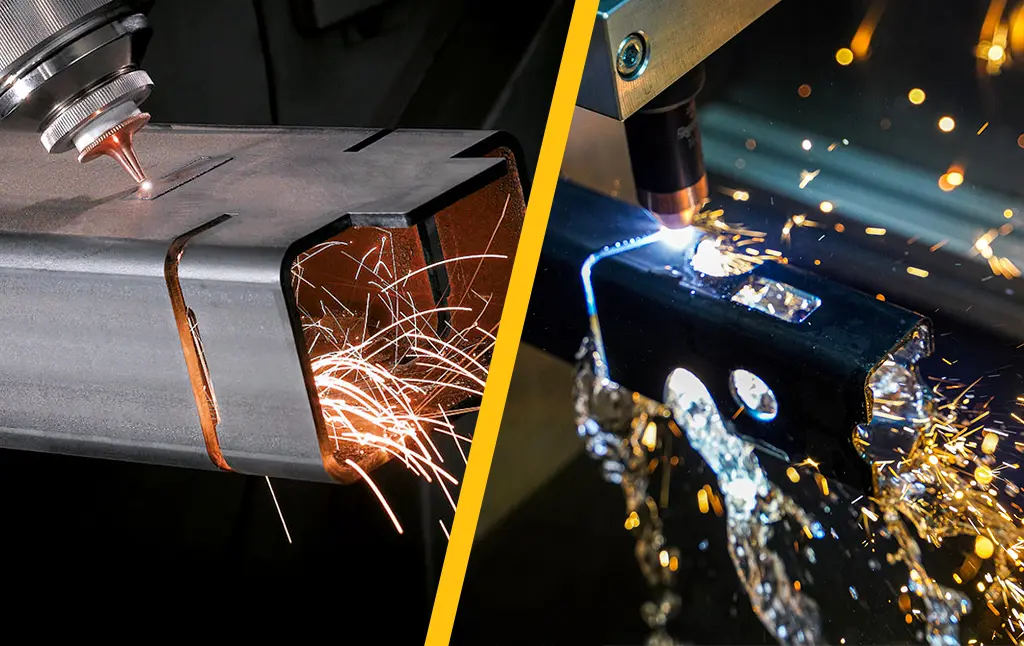
Tube cutting has come a long way from saws, punches and manual fabrication techniques. Today, two highly capable technologies dominate the market for processing round tube, box section, angle, channel and structural profiles: tube laser cutting and tube plasma cutting.
Both offer significant advantages over traditional methods, but they excel in different areas of cost, precision, speed and material capability. Choosing the right machine depends entirely on what you cut, how much you cut and the level of finish and accuracy your customers expect.
This guide breaks down the key differences, helping you decide whether a tube laser or a tube plasma system is the best fit for your workflow.
What Is Tube Laser Cutting?
A tube laser uses a focused fibre-laser beam to cut tube and profile materials with extremely high precision. These machines are designed to handle round tube, box section, RHS/SHS, angle, channel and a variety of open or custom profiles.
If you want to explore tube laser systems, Selmach’s range can be found here – Tube & Profile Fibre Laser Cutter Range
Tube lasers excel in:
-
High accuracy and repeatability
-
Clean edges with minimal or no finishing
-
Fast cutting speeds
-
Intricate feature cutting (slots, holes, mitres, joints)
-
Automated workflows and nesting
-
Consistent performance across shifts and operators
They’re typically chosen by workshops that need high-quality parts, tight tolerances, fast throughput and efficient production processes.
What Is Tube Plasma Cutting?
A tube plasma machine uses an electrically charged ionised gas (plasma) to cut through metal. The process is powerful, economical and well suited to larger profiles, heavier wall sections and jobs where high precision is not essential.
Selmach supplies the Morgan Rushworth SPM Tube & Section Plasma.
Tube plasma systems shine in:
-
Cutting thick-wall tube and heavy structural sections
-
Producing strong, robust cuts suitable for fabrication and construction
-
Lower initial investment cost
-
Good performance on general-purpose tube processing
-
Handling large-format work at a competitive price
They’re a practical choice for workshops needing versatility and value without the ultra-fine finish of a laser.
Key Differences: Tube Laser vs Tube Plasma
Below is a clear breakdown comparing the two technologies across the areas fabricators care most about.
1. Cutting Quality & Precision
Tube Laser:
-
Extremely fine kerf
-
Clean, square edges
-
High dimensional accuracy
-
Excellent for tight-fitting assemblies and weld-ready joints
-
Minimal grinding or secondary processing
Tube Plasma:
-
Wider kerf
-
More heat input
-
Some edge bevel or dross may be present
-
Good enough for structural or general fabrication
-
May require post-cut clean-up
Best for accuracy: Tube Laser
2. Cutting Speed
Tube Laser:
-
Faster on thin- and medium-wall materials
-
High acceleration, rapid piercing and quick feature transitions
-
Ideal for production work and batch runs
Tube Plasma:
-
Very fast on thicker wall sections
-
Slower on fine detail or smaller features
-
Less suited to intricate geometry
Best overall speed: Depends on material thickness
-
Thin to medium: Tube Laser
-
Heavy wall: Tube Plasma
3. Material Thickness Capability
Tube Laser:
-
Excels in thin to medium wall
-
Higher-power systems can handle thicker sections, but that’s not their primary strength
Tube Plasma:
-
Very capable on heavy wall tube and large structural profiles
-
Ideal for agricultural, construction, trailer, and industrial framework work
Best for thick-wall material: Tube Plasma (unless you opt for a high kW Tube Laser)
4. Profile Compatibility
Both technologies can handle a wide range of tube and section material, but with differences in detail cutting.
Tube Laser:
-
Excellent for complex profiles, intricate joints, slotting and detailed geometry
-
Consistent rotational accuracy
-
Capable of cutting open profiles with the right support systems
Tube Plasma:
-
Excellent for larger sections and general-purpose fabrication
-
Less precise for detailed features or close tolerance joints
Best for advanced geometry: Tube Laser
5. Cost (Initial & Running)
Tube Laser:
-
Higher initial investment
-
Lower running costs
-
Lower labour cost due to automation and reduced finishing
-
Higher overall part quality and consistency
Tube Plasma:
-
Lower initial investment
-
Consumables cost is moderate
-
Good balance of affordability and capability
-
Often chosen as an entry point into CNC tube profiling
Best for budget-conscious workshops: Tube Plasma
6. Typical Applications
Tube Laser Applications
-
Furniture frames
-
Architectural metalwork
-
Stainless steel frameworks
-
Automotive parts
-
Precision assemblies
-
Bespoke fabrication
-
High-volume, high-accuracy production
Tube Plasma Applications
-
Structural steel and construction
-
General fabrication
-
Agricultural machinery
-
Trailers, gates, barriers and large frameworks
-
Heavy-duty industrial components
So Which One Should You Choose?
It depends on what matters most to your workshop:
Choose a Tube Laser if you need:
-
High accuracy
-
Clean edges with minimal finishing
-
Fast cutting on thin/medium materials
-
Complex joints and detailed features
-
Automated, repeatable production
Explore Selmach’s Tube Laser options – Tube & Profile Fibre Laser Cutters
Choose a Tube Plasma if you need:
-
A cost-effective profiling solution
-
Large or heavy structural tube processing
-
Good quality suitable for general fabrication
-
Strong, practical cuts at an accessible price
See the plasma machine here: Morgan Rushworth SPM Tube & Section Plasma
Final Thoughts
Tube lasers and tube plasmas both offer significant advantages over manual cutting and traditional fabrication methods. The right choice depends on your material range, your required finish quality, your budget and your production speed expectations.
If you’re considering upgrading your tube cutting capabilities or want guidance on which technology suits your workload best, Selmach can help you compare options and plan a system that fits your future growth – contact us today!
Published 5th December 2025