
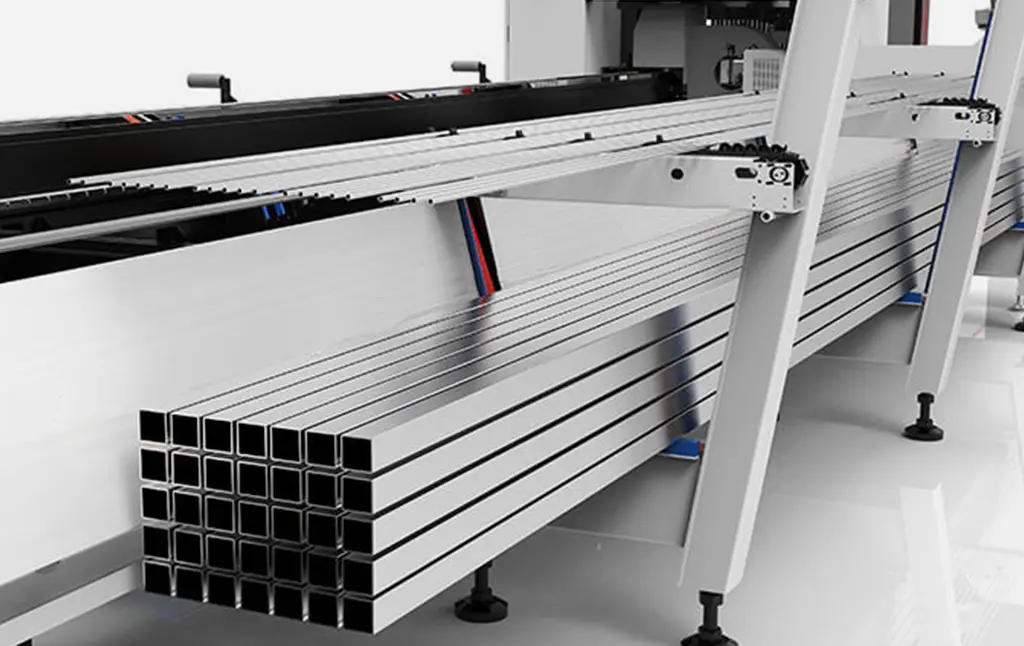
Many fabrication workshops struggle with a familiar dilemma: they need modern laser cutting capability — but they don’t have the floor space, volume demand, or investment budget to justify a large, heavy-duty tube-laser system. That’s where a compact and flexible machine like the RVD Smart Fibre TFC comes in: it delivers fibre-laser performance, profile flexibility and efficient workflow – while fitting into a modest footprint.
If your jobs involve small- to medium-sized tube or section profiles, mixed batches, or limited shop space, a compact tube laser could be exactly what transforms your productivity.
Compact But Capable: What “Compact” Means for the TFC
The TFC 6012 — the smallest in the range — offers:
-
A total floor footprint of 10.56 m long × 3.13 m wide × 2.08 m tall
-
A 6 m infeed and 2 m outfeed, allowing for a wide range of tube and profile lengths without consuming excessive floor space
For many workshops, these dimensions make it possible to install and run a tube-laser without large bays, structural modifications or severe layout changes. For smaller or multi-purpose shops (where space is shared or limited), that’s a major advantage.
Instead of dedicating a large area, you have a powerful cutting system that slides into a realistic footprint — combining modern capability with practical workshop real-estate.
Ideal for Small- and Medium-Section Work
The TFC is especially well suited to:
-
Round or rectangular tubes, RHS/SHS, box-sections and other hollow profiles
-
Light-to-medium structural sections, architectural profiles, decorative metalwork, handrails, frames, furniture, and small-batch production
-
Work situations where throughput is moderate, profile variety is high, and the workload doesn’t demand large-scale structural cutting
In other words: if you predominantly work with manageable tube/section sizes, mixed jobs, and varied orders — a compact fibre-laser system often suits perfectly as “just right”.
Flexible Loading: Semi-Auto or Bundle Loading — You Choose
One of the TFC’s standout features is its dual-loading system. You can operate — practical for small batches, prototypes or occasional jobs
-
Bundle / magazine loading mode — ideal for when you need to process multiple tubes in succession without frequent manual intervention
This flexibility means the machine adjusts to your workflow: run it manually when volume is low, or switch to semi-auto when production ramps up. For small-to-mid shops, that adaptability minimises downtime and maximises productivity — without locking you into large-batch commitments.
Fibre-Laser Advantages: Precision, Clean Cuts, Low Waste
Using a fibre laser brings a set of benefits that match perfectly with the kind of work a compact machine is designed for:
-
Tight tolerances, narrow kerf, and precise cuts — ideal for jobs needing accuracy and clean weld-prep edges.
-
Minimal heat-affected zone compared with mechanical or plasma cutting — reducing distortion and improving edge quality, especially on thinner or medium-thickness material.
-
Reduced need for post-cut finishing or grinding — saving time and labour, which matters more when batch volumes are modest and manual handling is relatively significant.
For workshops making architectural railing, frames, furniture, precision components or structural items for medium-duty applications — the precision and cleanliness of fibre-laser output pays off immediately.
Who Should Seriously Consider the TFC?
The TFC hits a sweet spot for:
-
Small or medium-size fabrication shops lacking large bays or dedicated laser rooms
-
Businesses working on mixed orders — custom jobs, smaller batches, light structural or architectural work
-
Workshops that value flexibility: occasional jobs, variable lengths, mixed material orders, but want modern cutting quality
-
Fabricators wanting to modernise workflows without heavy upfront investment or space commitment
If your production mix includes a lot of different tube/section sizes, frequent changeovers, and you prioritise accuracy and efficiency over heavy structural throughput — the TFC could be exactly right for you.
What Compact Means and What You Should Still Check
While compact machines like the TFC offer great flexibility, there are trade-offs compared with larger, heavy-duty lasers:
-
Maximum tube/section length and thickness may be limited compared with long-bed systems, not ideal for extremely long beams or very heavy structural sections
-
For very high-volume structural fabrication, larger machines might still be necessary
-
If you foresee scaling up workload significantly, consider whether future demands exceed what a compact machine can handle
In short: make sure your typical workload — tube sizes, wall thickness, production volume and profile type — matches what a compact laser is built to handle.
If you need the larger capacity, consider the RVD Smart Fibre TFL instead, which is built perfectly for processing those larger sections.
Why the RVD Smart Fibre TFC Could Be the “Sweet-Spot” Choice for Many UK Fabricators
For workshops needing modern cutting capability — but without the space, volume or capital for a full-scale, heavy-duty laser — the TFC offers a compelling middle ground.
It blends:
-
A compact footprint that fits many existing workshops
-
Flexible loading options for mixed jobs or batch work
-
Fibre-laser precision and clean cuts for a wide range of tube and section work
-
Cost-effectiveness and ease-of-installation compared with large-bed machines
If you’re working with small or medium tube/section profiles, doing mixed or bespoke jobs, or simply want to modernise your cutting without committing to heavy-duty infrastructure — the RVD Smart Fibre TFC may be the efficient, flexible heart your workshop needs.
Explore the full range of Tube & Section Fibre Laser Cutter machinery.
Published 5th December 2025